How to Get Scholarship at Texas University is more straightforward than most international students realize — but only if you know the system. The biggest mistake students make is treating scholarships as a separate, competitive process that happens after admission.
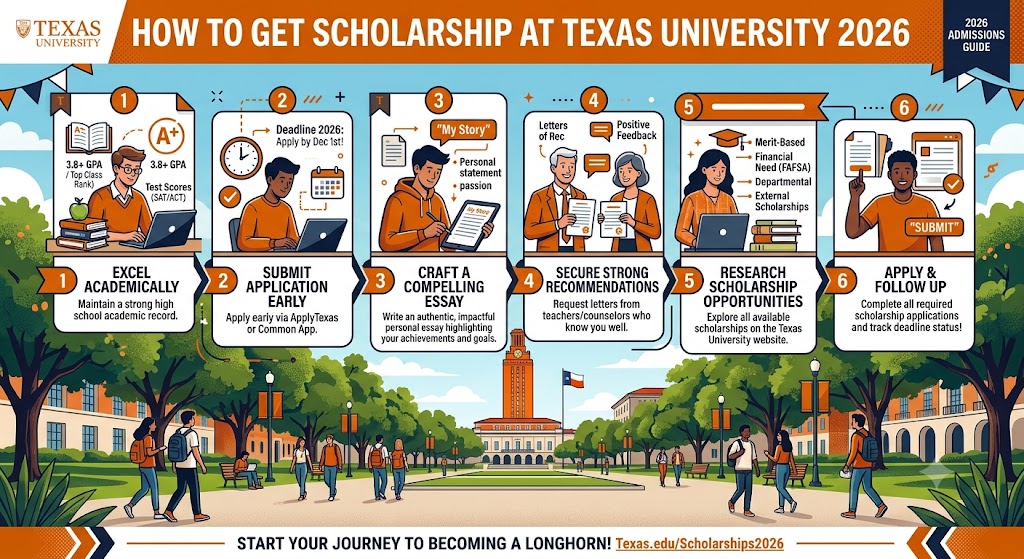
At most Texas universities, the most valuable scholarships are automatically considered when you apply for admission — no separate application required. Apply early, submit the right documents, and let the system work for you. This guide explains exactly how to do that, step by step, for every major scholarship type available at Texas universities.
The 5 Types of Texas University Scholarships (And Which One to Target)
| Type | Amount | Automatic? | Who It’s For | Key Deadline |
|---|---|---|---|---|
| Automatic Merit Scholarship | $1,000–$12,000/yr | ✅ Yes | All strong applicants | Varies by university |
| Non-Resident Tuition Waiver | $8,000–$27,000/yr | ✅ Triggered by merit scholarship | Out-of-state & international | Same as merit deadline |
| Good Neighbor Scholarship | Full non-resident premium | ❌ Must apply via THECB | Western Hemisphere nationals | Contact each university |
| Competitive/Departmental Scholarship | $500–$52,000/yr | ❌ Separate portal application | Strong academic profile | Nov 1 – March 1 |
| Need-Based Aid (TASFA/FAFSA) | Varies | ❌ Must file TASFA or FAFSA | Students with financial need | March 1–May 1 |
Step 1 — Apply for Admission EARLY (Most Important Step)
The single most important thing you can do to maximize your scholarship at a Texas university is apply before the scholarship priority deadline. At every Texas university, scholarship consideration is tied directly to your admission application — and priority deadlines determine who gets first access to scholarship funds.
Most students assume they can apply in March or April and still get scholarships. They cannot. By the time late applications are reviewed, most scholarship funds have already been committed to earlier applicants.
Priority Scholarship Deadlines by University
| University | Priority Scholarship Deadline | What Happens If You Miss It |
|---|---|---|
| Texas A&M | December 1 | Still reviewed but scholarship funds reduced |
| UT Dallas (AES) | December 1 | AES not guaranteed after this date |
| Texas Tech | December 1 | Presidential Scholarship pool diminished |
| Baylor University | November 1 (ED1) | Merit scholarships still available at ED2/RD |
| TCU | November 1 (ED) | Regular Decision scholarships available |
| SMU | November 1 (ED) | Regular Decision by January 15 |
| UNT | March 1 | Excellence Scholarship pool reduced |
| Midwestern State | March 1 | Auto merit scholarship still possible |
| Tarleton State | February 15 | 600+ scholarships still open but reduced pool |
| Sul Ross State | January 15 | April 1 final deadline — apply anyway |
| Sam Houston State | November 1 | Scholarships4Kats open until funds depleted |
Rule of thumb: Apply in October or November for fall admission the following year. This gives you the best possible position for all automatic and competitive scholarship pools.
Step 2 — Understand Automatic Merit Scholarships (No Separate Application)
This is the most underused and misunderstood scholarship mechanism in Texas. At most Texas universities, you are automatically considered for merit scholarships when you submit your admission application. There is nothing additional to do — the scholarship review happens as part of your admission file review.
How Automatic Merit Scholarships Work at Each University
Texas A&M University
Applying for scholarships is a simple two-step process: Complete the admission and scholarship applications on Common App or Apply Texas. Students must provide consent for application data to be used for scholarship consideration at the time of application. Students who decline will not be considered for scholarship opportunities through Texas A&M University.

At TAMU, the scholarship process is literally embedded in the admission application. Apply by December 1, provide consent for your data to be used for scholarship consideration, and submit any supplementary materials requested. That’s it. You will receive your scholarship notification alongside or shortly after your admission decision.
UT Dallas — Academic Excellence Scholarship (AES)
Submit a complete admission file by December 1. AES is automatically considered for all applicants. No separate form, no scholarship essay, no additional portal — the AES review is holistic and based on your entire admission file. Recipients also automatically qualify for in-state tuition rates regardless of residency — saving approximately $ 25,000+ per year for international students.
University of North Texas — Excellence Scholarship
Apply by March 1. Excellence Scholarship is automatically considered for all first-time freshmen. No separate application. Awards range from $1,000 (Scrappy Scholarship) to $12,000/year (President’s Elite). Any tier qualifies international students for an in-state tuition waiver. Transfer students apply by June 1.

Texas Tech University
Texas Tech University is proud to offer a high-quality education at an affordable cost. Merit- and competitive-based scholarships are awarded to exceptional new and continuing students each year. Apply by December 1 for fall freshman priority. Presidential Merit Scholarship requires admission by this deadline. Scholarships are automatically considered — no separate application for most merit awards.

Baylor University
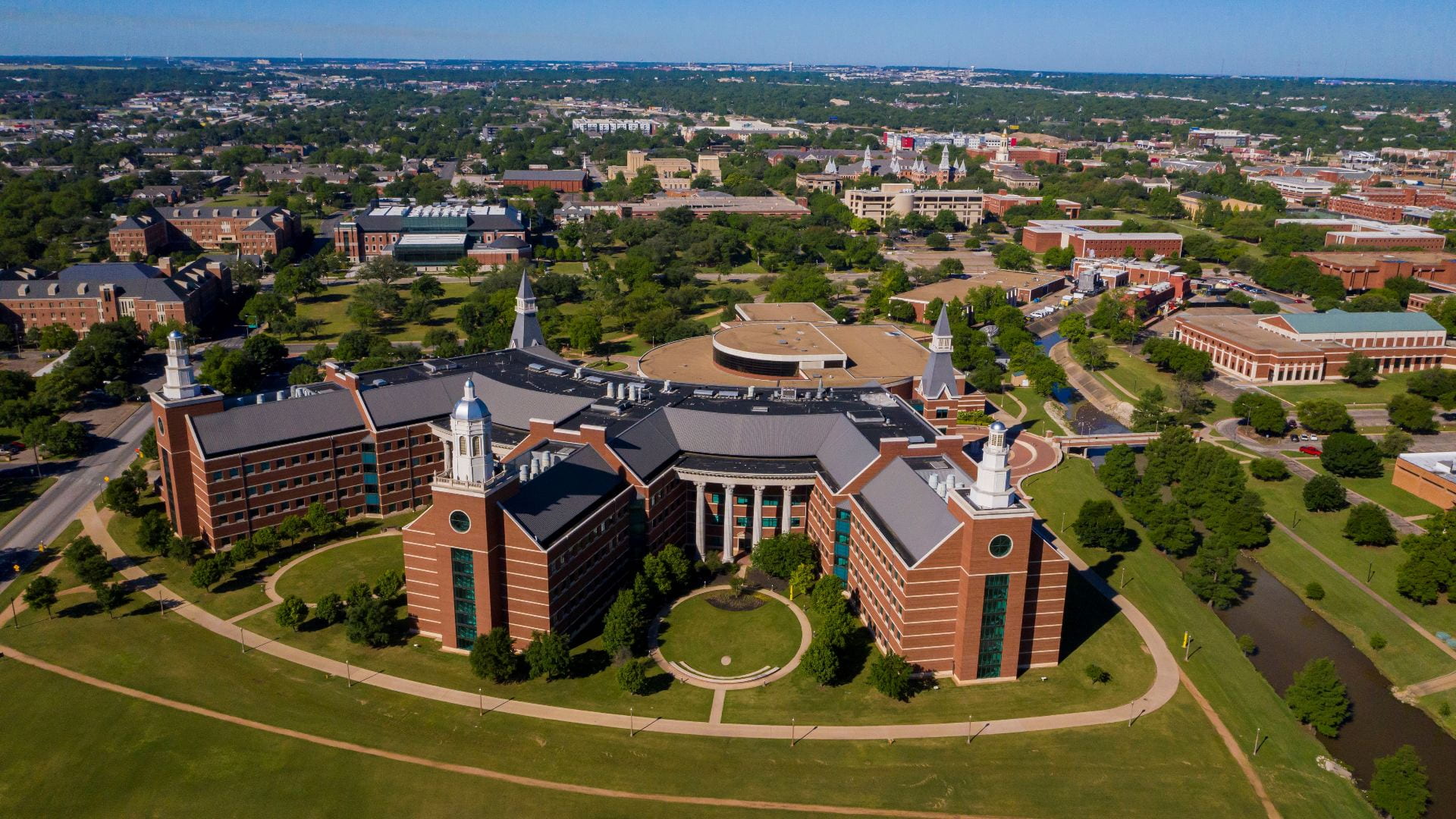
Merit scholarships are reviewed holistically with every admission application. Apply by November 1 (Early Decision 1) or January 1 (Early Decision 2) for best scholarship consideration. No application fee for international undergraduates — making Baylor one of the most accessible scholarship targets for international students. Scholarship notification arrives with or shortly after admission decision.
Texas Christian University (TCU)
All applicants are automatically considered for academic merit scholarships through holistic review. Apply Early Decision (November 1) for best scholarship results. International average scholarship: $25,000/year with maximum combined award of $51,570/year. CSS Profile required for need-based aid by February 1.

Lubbock Christian University
The F.W. Mattox Presidential Scholar and Cornerstone Scholars (full tuition awards) are nomination-based through the admissions process — automatically identified during your standard application review. Contact LCU Admissions directly and discuss your academic profile to maximize consideration.

Step 3 — Unlock the Non-Resident Tuition Waiver (Most Valuable for International Students)
This is the single most financially impactful scholarship mechanism for international students at Texas public universities — and very few students understand it.
How it works: Texas law allows any non-resident student (domestic or international) who receives a competitive institutional scholarship of $1,000 or more to pay Texas in-state tuition instead of out-of-state rates. At most Texas public universities, in-state tuition is $8,642–$14,644/year. Out-of-state/international tuition is $19,000–$41,000/year. The difference is the waiver value.
| University | Scholarship Required | In-State Tuition (After Waiver) | Waiver Value/Year |
|---|---|---|---|
| Lamar University | Auto (grad) / $1,000+ (UG) | ~$8,642 | ~$11,443 |
| Sul Ross State | $1,000+ | ~$7,592 | ~$10,080 |
| Texas Tech | Presidential Scholarship | ~$11,852 | ~$12,599 |
| Midwestern State | $1,000+ | ~$9,950 | ~$12,960 |
| Tarleton State | $1,000+ | ~$10,180 | ~$12,300 |
| UNT | Any Excellence Scholarship | ~$13,506 | ~$7,738–$14,601 |
| UT Dallas | Any AES level | ~$14,644 | ~$25,500 |
| Texas A&M (UG) | $4,000 combined | ~$12,995 | ~$27,129 |
| Texas A&M (Grad) | $1,000+ | ~$11,748 | ~$12,757 |
Critical rule: The scholarship must be a competitive institutional award open to both Texas residents and non-residents. Scholarships specifically designated for international students only (like ITPEG or IEFS at TAMU) do NOT qualify for this waiver. Always confirm waiver eligibility with the Financial Aid Office after receiving your scholarship notification.
Step 4 — Apply for the Good Neighbor Scholarship (Western Hemisphere Students)
If you are a citizen of a Western Hemisphere country (excluding Cuba and the U.S.), you may qualify for the Good Neighbor Scholarship — a state-administered program providing a full non-resident tuition exemption at any Texas public university.
Good Neighbor Scholarship — Key Facts
- Who administers it: Texas Higher Education Coordinating Board (THECB)
- What it covers: Full non-resident tuition premium — you pay in-state tuition only
- Where available: All Texas public universities
- Annual awards: 235 statewide across all universities
- Key requirement: Must intend to return to home country after completing degree
- Visa status: Must be in non-immigrant visa status (F-1 qualifies)
- Note: TAMU requires completion of at least one full academic semester before Good Neighbor eligibility; other universities may have different requirements
How to Apply for Good Neighbor Scholarship
- Be admitted to a Texas public university
- Contact your university’s International Student Services office and ask specifically about the Good Neighbor Scholarship process
- Submit the THECB Good Neighbor application along with your university’s supplemental materials
- Demonstrate academic merit and intent to return home after graduating
Since only 235 awards are made statewide annually, the Good Neighbor is competitive. Apply at the university with the lowest in-state tuition to maximize financial benefit — Sul Ross State University ($7,592 in-state) or Midwestern State University ($9,950 in-state) give the highest value per award.
Step 5 — Apply Through the Scholarship Portal (Competitive Departmental Awards)
Beyond automatic merit scholarships, every Texas university has a scholarship portal where you can apply for additional competitive, departmental, and special-interest scholarships. These require a separate application — but one general application typically matches you against dozens or hundreds of available awards.
Scholarship Portals by University
| University | Portal Name | Priority Deadline |
|---|---|---|
| Texas A&M | University Scholarship Application (USA Portal) | February 1 |
| UT Dallas | Artemis Scholarship Portal (utdallas.academicworks.com) | After admission (open year-round) |
| UNT | Eagle Scholarship Portal (ESP) | March 31 (academic achievement) |
| Texas Tech | Scholarship Application Portal (scholarships.ttu.edu) | December 1 (fall priority) |
| Tarleton State | Tarleton Scholarship Portal | February 15 |
| Sam Houston State | Scholarships4Kats (shsu.academicworks.com) | November 1 |
| Texas State | BOSS (Bobcat Online Scholarship System) | December 15 |
| Angelo State | RamPort Scholarship Application | January 15 |
| Sul Ross State | Sul Ross Scholarship Application | February 1 |
| UT Austin | Texas Exes Scholarships (texasexes.academicworks.com) | March 1 |
Entering Freshmen — Application opens September 1. Deadline: March 1 at 11:59 pm CST. Recipients are chosen by the Texas Exes scholarship selection committees each spring.
How to maximize portal scholarships:
- Complete your profile thoroughly — most portals auto-match you to relevant awards based on your profile fields
- Do not skip optional fields — scholarship committees use all available data
- Write strong essays even for small awards — essay quality is often the differentiating factor
- Apply immediately after gaining portal access — don’t wait until the deadline
- Check the portal regularly — new scholarships are often added throughout the academic year
Step 6 — File TASFA for Need-Based Aid (International Students)
The Texas Application for State Financial Aid (TASFA) is the Texas equivalent of FAFSA for students who are not U.S. citizens or eligible non-citizens. International students in Texas can use TASFA to apply for state-funded and institutional need-based grants and scholarships.
Beginning the 2026–2027 academic year, the TASFA will replace the ISFAA for international students at Texas A&M University. International student financial aid is based on financial need, not academic performance. This aid is intended to supplement a student’s existing funds and does not cover all educational costs.
TASFA Basics for International Students
| Detail | Information |
|---|---|
| Who should file | International students with financial need at Texas public universities |
| What it unlocks | ITPEG (up to $4,000), institutional need-based grants, some scholarships requiring demonstrated need |
| When to file | As early as possible each academic year — October 1 recommended start date |
| TAMU priority deadline | May 1 (2026–27 academic year) |
| Most Texas universities | March 1–May 1 priority deadlines |
| Available at | tasfa.thecb.texas.gov |
| Annual filing | Must be filed every academic year — not a one-time application |
Important: Funding for international aid is limited and not guaranteed. Eligibility requirements for specific types of aid are listed below. Not all students who are eligible will receive this funding. TASFA-based aid is supplemental — it does not cover full tuition and living costs. Think of it as additional funding that stacks with your merit scholarships.
Step 7 — Submit SAT/ACT/GRE/GMAT Scores Voluntarily
Most Texas universities are test-optional for admission — but submitting standardized test scores can move you into a higher scholarship tier even when they’re not required.
| University | Test Score Benefit |
|---|---|
| UNT | SAT/ACT submission earns an additional $1,000/year bonus award (stackable on Excellence Scholarship) |
| ACU | ACU superscores all tests; higher scores = higher merit tier; Presidential Scholarship requires test score |
| Texas Lutheran | SAT 1100+ or ACT 22+ earns additional $1,000–$3,000 stackable award |
| Dallas Baptist | SAT 1140+ or ACT 25+ may qualify for Founders-level scholarship |
| Tarleton State | ACT/SAT scores considered alongside GPA for highest scholarship tiers |
| Sul Ross | ACT 25+ or SAT 1150+ required for President’s Endowed Scholars Program |
Strategy: If you have strong SAT/ACT scores — submit them voluntarily at every Texas university. The upside is real (higher scholarship tier, bonus awards), and there is no downside since test-optional policies mean scores only help, never hurt your admission chances.
Step 8 — Stack Your Scholarships
One of the most important Texas university scholarship strategies is stacking — combining multiple awards that can be held simultaneously. Most Texas universities allow multiple scholarship types to stack up to the total cost of attendance.
Stackable Award Combinations That Work
- Automatic Merit Scholarship + Non-Resident Tuition Waiver — most powerful combination. At UTD: AES ($2,000–$10,000) + in-state tuition waiver ($25,500 saving) = dramatic total cost reduction
- Merit Scholarship + Departmental Scholarship — apply through both the admission process and the scholarship portal to stack awards from different sources
- Merit Scholarship + Texas Exes Scholarship (UT Austin) — alumni-funded awards stack with institutional merit
- Merit Scholarship + Church Matching Scholarship (HBU) — if your Christian church donates scholarship funds, HBU matches dollar-for-dollar up to $1,000
- PTK Membership + Transfer Scholarship (multiple universities) — Phi Theta Kappa honor society membership unlocks additional transfer scholarship tiers at Tarleton, Concordia Texas, and others
- Music/Art/Theatre Talent Award + Academic Merit — performing arts and studio arts scholarships at most Texas universities stack with academic merit awards
- Honors College Award + Academic Merit — being admitted to the Honors College at UT Dallas, UNT, or Angelo State typicallyadds aa scholarship layer.
Important rule: Combined scholarship awards generally cannot exceed the total cost of attendance. If you are awarded more than COA, excess funds are typically returned or reduced. Always verify stacking policies with the Financial Aid Office before counting on combined totals.
Step 9 — Apply for External Scholarships
External scholarships — from government agencies, corporations, foundations, and community organizations — can supplement your Texas university institutional awards. Key sources for international students:
Government-Funded External Scholarships
- Fulbright Foreign Student Program — U.S. government scholarship for graduate study; covers tuition, fees, living stipend, and health insurance; highly competitive; apply in your home country 1–2 years before intended start
- AAUW International Fellowships — for women pursuing graduate study in the U.S.; $18,000–$30,000 fellowships
- Rotary Foundation Global Grants — for graduate students pursuing studies aligned with Rotary’s areas of focus (peace, disease prevention, water, education); contact your local Rotary club to apply
- Joint Japan/World Bank Graduate Scholarship Program — for development-focused graduate studies; covers tuition, living costs, and travel
- Your home country government scholarships — India (ICCR scholarships), China (CSC scholarships), Nigeria (PTDF scholarships), Pakistan (HEC scholarships) all fund international study in the U.S.
Texas-Specific External Awards
- Terry Foundation Scholarship — available at UT Austin, Texas A&M, Texas Tech, UT Dallas, and other Texas universities; covers full COA for top Texas high school graduates
- Texas Exes Scholarships (UT Austin) — application opens September 1; deadline March 1 at 11:59 pm CST; alumni-funded awards for incoming UT Austin students
- TASSP Scholarships — for student council leaders
- National Merit Scholarship — for National Merit Finalists who designate specific Texas universities; TAMU pays $10,000/year, UT Dallas pays competitively, Baylor and Texas Lutheran offer strong packages
Corporate Scholarships
- Texas Instruments Foundation Scholarships
- ExxonMobil Education Foundation
- AT&T Aspire Program
- IEFA Scholarship Search Engine (iefa.org) — searchable database by country of origin
Step 10 — Maintain Your Scholarship (Renewal Requirements)
Getting the scholarship is only half the battle. Losing it for failing to meet renewal requirements can be a financial catastrophe. Every Texas university scholarship has renewal conditions — know them before you arrive on campus.
| University | Typical Renewal GPA | Credit Hours Required | Other Conditions |
|---|---|---|---|
| Texas A&M | 3.0+ | 24 per academic year | Consent to data use maintained |
| UT Dallas (AES) | 3.0+ | 12 per semester | Full-time enrollment |
| UNT | 3.0+ | 12 per semester; 24/yr | Full-time enrollment |
| Texas Tech | Varies by award | Full-time enrollment | Annual FAFSA/TASFA recommended |
| Baylor | Merit varies | Full-time enrollment | Continued good standing |
| Midwestern State | 2.0+ | 12 per semester | Full-time enrollment |
| Tarleton State | 2.5+ | Full-time enrollment | Annual application through portal |
Warning signs that put your scholarship at risk:
- Dropping below full-time enrollment (12 UG / 9 Grad credit hours) without DSO and Financial Aid approval
- GPA falling below the scholarship renewal threshold even for one semester
- Changing majors to a different department that has different scholarship conditions
- Taking a leave of absence without formally notifying the Financial Aid Office
- Failing to file TASFA annually when it is required for your scholarship
If your GPA drops below the renewal threshold in any semester, immediately contact the Financial Aid Office — most Texas universities have a scholarship appeal process that can restore scholarships lost due to extenuating circumstances (illness, family emergency, etc.).
Complete Scholarship Calendar for Texas University Applicants
| Month | Action |
|---|---|
| August–September | Submit admissions applications to Texas universities (aim to be submitted by October) |
| September 1 | Texas Exes Scholarship application opens (UT Austin); TASFA available at many schools |
| October 1 | FAFSA opens (domestic students); RamPort scholarship portal opens (Angelo State) |
| November 1 | Early Decision deadline — Baylor (ED1), TCU (ED), SMU (ED); Sam Houston State Scholarships4Kats priority deadline |
| December 1 | Texas A&M scholarship priority deadline; UT Dallas AES deadline; Texas Tech fall priority deadline; Baylor ED2 |
| December 15 | Texas State University (BOSS) freshman scholarship deadline; UT Austin Regular Decision |
| January 1 | Sul Ross scholarship application opens; Baylor ED2 deadline; TCU Regular Decision |
| January 15 | Sul Ross early scholarship co.nsideration; Angelo State (RamPort) priority deadline |
| February 1 | TAMU USA Portal scholarship deadline; TCU CSS Profile deadline; Sul Ross early consideration |
| February 15 | Tarleton State scholarship priority deadline; TLU Early Deposit Discount deadline |
| March 1 | UNT Excellence Scholarship priority deadline; Texas Exes deadline; Midwestern State priority; Sul Ross general deadline; UNT ESP Academic Achievement deadline; SMU Regular Decision |
| March 15 | FAFSA priority deadline (most Texas universities) |
| March 31 | UNT Eagle Scholarship Portal (Academic Achievement) deadline |
| April 1 | Sul Ross final scholarship deadline; LCU Priddy Scholars deadline; ACU Departmental scholarship deadlines |
| May 1 | TASFA priority deadline at TAMU; Midwestern State fall deadline |
The 7 Biggest Scholarship Mistakes International Students Make at Texas Universities
- Applying too late — applying in March for August enrollment means 90% of scholarship funds are already committed. Apply in October or November
- Not consenting to scholarship consideration — at Texas A&M specifically, you must actively consent to scholarship data use. Students who skip this are never reviewed
- Not submitting test scores voluntarily — if you have strong SAT/ACT/GRE scores, submitting them voluntarily can unlock higher scholarship tiers and bonus awards at UNT, TLU, and others
- Ignoring the scholarship portal after admission — automatic merit is just the start. Log into the scholarship portal (Artemis, BOSS, Scholarships4Kats, RamPort, ESP) immediately after receiving your NetID/student ID
- Not filing TASFA — international students with financial need who skip TASFA leave need-based grants and ITPEG funds on the table
- Assuming the Non-Resident Waiver is automatic — it is not. You must receive a qualifying competitive scholarship first, and you must confirm waiver application with the Financial Aid Office
- Not maintaining renewal GPA — losing a scholarship mid-degree due to a GPA drop is far more financially damaging than not getting one. Know your renewal terms from day one
Final Thoughts
The Texas university scholarship system rewards students who understand how it works and act early. Apply before November or December for maximum scholarship access. Let automatic merit systems work in your favor. Apply through the scholarship portal for additional competitive awards. If you are from a qualifying Western Hemisphere country, pursue the Good Neighbor Scholarship. File TASFA for need-based supplemental aid. And if you have strong test scores — submit them.
For the full scholarship breakdowns at individual Texas universities, see our complete guides:
- Texas Universities with Full Scholarships 2026
- 10 Cheapest Texas Universities for International Students
- Best Texas Universities for Indian Students 2026–27
- F-1 Student Visa Guide for Texas Universities 2026
Have questions about Texas university scholarships or which award you qualify for? Drop them in the comments below — we’ll give you our honest assessment.
Leave a Reply