Every international student at a Texas university — whether at UT Austin, Texas A&M, UNT, or any other institution — needs an F-1 student visa to study in the United States. The process is well-defined but has strict deadlines, required sequences, and critical details that, if missed, can delay your enrollment or cancel your visa entirely.
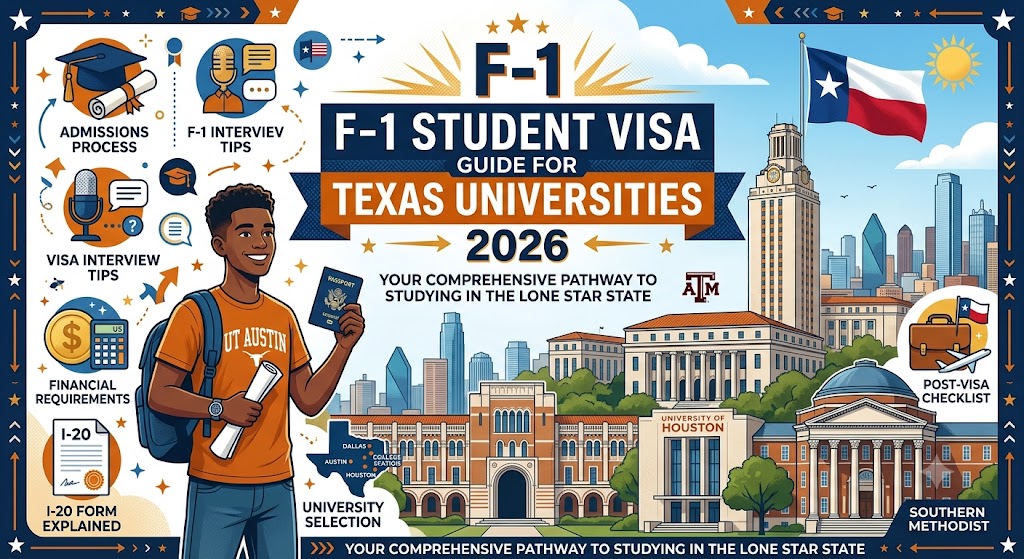
This guide covers every step — from acceptance letter to arrival in Texas — with the exact fees, forms, deadlines, and interview tips you need to get it right the first time.
What Is the F-1 Student Visa?
The F-1 is a non-immigrant visa that allows international students to enter the United States and study full-time at a Student and Exchange Visitor Program (SEVP)-certified institution. Every accredited university in this guide — from Rice University to Sul Ross State University — is SEVP-certified, meaning they are authorized to issue the I-20 form required to begin the F-1 visa process.
Key F-1 facts every student should know before starting:
- The F-1 visa is tied to your I-20 form and SEVIS record, not just the visa stamp in your passport. Your visa stamp can expire while you remain in valid F-1 status — what matters is that your I-20 is current and your enrollment is active
- F-1 status requires full-time enrollment — typically 12+ credit hours per semester for undergraduates, 9+ for graduate students
- F-1 students can work on-campus up to 20 hours per week during the semester (unlimited during breaks) without additional authorization
- Off-campus work during studies requires Curricular Practical Training (CPT) authorization from your university’s Designated School Official (DSO)
- Post-graduation work requires Optional Practical Training (OPT) authorization from USCIS
- The F-1 visa stamp can only be issued within 120 days of your program start date — applying too early means waiting
The F-1 Visa Process — Complete Step-by-Step
Step 1 — Get Accepted to a Texas University and Request Your I-20
The F-1 visa process cannot begin until you have been unconditionally admitted to a SEVP-certified Texas university and that university has issued your Form I-20 (Certificate of Eligibility for Nonimmigrant Student Status).
To receive your I-20, most Texas universities require:
- Unconditional admission letter
- Proof of financial support for at least one full academic year (bank statements, sponsor letters, or scholarship award letters totaling your university’s stated annual COA)
- Completed International Student Financial Statement or equivalent form (varies by university)
- Copy of your valid passport (biographical page)
Your I-20 will be issued by your university’s Designated School Official (DSO) — typically through the International Student Services or International Programs office. Universities in Texas typically mail physical I-20s or send them electronically via iSHP, Atlas, or similar platforms.
Allow 2–4 weeks for I-20 processing after submitting all required documents. If you are changing universities or transferring your SEVIS record from a previous U.S. institution, notify both schools’ international offices well in advance.
| Texas University | International Office |
|---|---|
| UT Austin | ISSS — isss.utexas.edu |
| Texas A&M | ISSS — isss.tamu.edu |
| University of Houston | International Student Services — uh.edu/iss |
| UT Dallas | International Student Services — utdallas.edu/iss |
| Texas Tech | International Affairs — depts.ttu.edu/international |
| UNT | International Affairs — international.unt.edu |
| Baylor | International Student Services — baylor.edu/international |
| SMU | International Student & Scholar Services — smu.edu/isss |
| TCU | International Student Services — tcu.edu/iss |
| Rice | International Students & Scholars — isss.rice.edu |
Step 2 — Pay the SEVIS I-901 Fee ($350)
Before applying for your F-1 visa, you must register in the Student and Exchange Visitor Information System (SEVIS) and pay the I-901 SEVIS fee of $350.
How to pay:
- Go to fmjfee.com — the official SEVIS fee payment site
- Enter your SEVIS ID number (found in the top right of your I-20 form, beginning with “N”)
- Pay $350 by credit/debit card or check
- Print and save your payment receipt — you must bring this to your visa interview
Critical rules:
- Pay the SEVIS fee at least 3 business days before your visa interview — payment must be processed and confirmed in the system before your interview
- Pay the fee no earlier than 30 days before your program start date if you want it linked to your current I-20. If your program start date is still far away, paying too early may cause the fee to expire before your enrollment begins
- If you do not pay the SEVIS fee at least 30 days before your program start date, your SEVIS record may be cancelled
- The $350 SEVIS fee is separate from the $185 visa application fee — both must be paid
Step 3 — Complete the DS-160 Online Visa Application
The DS-160 is the U.S. Department of State’s online nonimmigrant visa application form. It must be completed and submitted electronically at ceac.state.gov before your visa interview.
What you’ll need to complete the DS-160:
- Valid passport (must be valid for at least 6 months beyond your intended stay)
- Your I-20 form (SEVIS ID, program information, school details)
- Travel history (countries visited in the past 5 years)
- Employment history
- Social media handles (Instagram, Twitter/X, Facebook, LinkedIn — required as of 2019 policy)
- Digital photograph meeting U.S. visa photo requirements (square, light background, no glasses)
- U.S. contacts (your university’s DSO contact information is acceptable)
Important DS-160 tips:
- Save your DS-160 application ID frequently — the session can time out
- Print the DS-160 confirmation page (the barcode page) after submission — bring it to your interview
- Answer all questions truthfully and completely — inconsistencies between DS-160 and interview answers are a common reason for visa denial
- Your DS-160 must be submitted at least 48 hours before your visa interview
Step 4 — Pay the MRV Visa Application Fee ($185)
The Machine Readable Visa (MRV) fee is the visa application processing fee — currently $185 for F-1 student visas. This is separate from the SEVIS fee.
How to pay:
- Pay through the U.S. Embassy or Consulate’s official payment portal for your country — visit usembassy.gov and select your country for specific payment instructions
- Keep your payment receipt — required to schedule your visa interview appointment
- Note: Some nationalities also pay an additional reciprocity fee based on fees their home country charges U.S. citizens — check usembassy.gov for country-specific amounts
Total mandatory government fees: $535 ($350 SEVIS + $185 MRV)
Step 5 — Schedule Your Visa Interview
F-1 student visas require an in-person interview at a U.S. Embassy or Consulate in your home country. As of the U.S. Department of State’s updated Interview Waiver policy, most applicants, including those under 14 and over 79, are now required to attend in-person interviews.
To schedule your interview:
- Go to https://www.ustraveldocs.com/ or your country’s U.S. Embassy scheduling portal
- Select the nearest U.S. Embassy or Consulate
- Select “Student (F)” as your visa type
- Select an available appointment date and time
- Print your appointment confirmation
Wait times vary dramatically by country and season:
| Country | Typical Wait Time (Summer Peak) | Recommended Lead Time |
|---|---|---|
| India | 4–12 weeks | Apply 4–6 months before start date |
| China | 4–8 weeks | Apply 3–5 months before start date |
| Nigeria | 8–16 weeks | Apply 5–6 months before start date |
| Pakistan | 4–10 weeks | Apply 4–6 months before start date |
| Mexico | 1–4 weeks | Apply 2–3 months before start date |
| South Korea | 1–3 weeks | Apply 2–3 months before start date |
| Brazil | 2–6 weeks | Apply 3–4 months before start date |
| Most other countries | 1–3 weeks | Apply 2–3 months before start date |
Important rule: Your F-1 visa stamp can only be issued within 120 days of your program start date. If your interview is scheduled more than 120 days before your program begins, you will be interviewed, but your visa will not be issued until you are within the 120-day window.
Step 6 — Prepare Your Documents for the Interview
Arriving at your visa interview with all required documents organized and accessible is one of the most important preparation steps. Missing a document can result in refusal or administrative processing delays.
Required documents for your F-1 visa interview:
| Document | Notes |
|---|---|
| Valid passport | Must be valid for at least 6 months beyond your program end date |
| DS-160 confirmation page | Print the barcode page after submitting online |
| MRV fee payment receipt | Proof of $185 visa application fee payment |
| SEVIS I-901 fee receipt | Proof of $350 SEVIS fee payment from fmjfee.com |
| Form I-20 | Original, signed by your DSO — do not fold or damage it |
| Visa interview appointment confirmation | Print from scheduling portal |
| Admission letter | Official unconditional offer letter from your Texas university |
| Financial documents | Bank statements, scholarship letters, sponsor letters — showing sufficient funds for at least one year |
| Academic transcripts | Official transcripts from all institutions attended |
| Standardized test scores | TOEFL/IELTS, GRE/GMAT/SAT — photocopies acceptable at interview |
| Proof of ties to home country | Property ownership, family ties, employment offer, bank accounts — demonstrates intent to return after completing degree |
| Passport photos | 2 photos meeting U.S. visa photo standards (if upload failed during DS-160) |
| Previous U.S. visas | Bring any prior U.S. visa pages if applicable |
Step 7 — Attend Your Visa Interview
The visa interview is typically 10–15 minutes — consular officers make decisions quickly based on your documents and answers. The interview is conducted in English (bring an interpreter only if necessary and permitted by the embassy).
What Consular Officers Are Evaluating
Every F-1 visa decision revolves around two core questions the consular officer is trying to answer:
- Are you a legitimate student? — Do you have a real, genuine academic purpose in the U.S.?
- Will you return home after your studies? — Do you have sufficient ties to your home country that make you likely to return?
Common Interview Questions and How to Answer Them
| Question | Strong Answer Approach |
|---|---|
| Why do you want to study in the U.S.? | Specific reasons — program quality, research opportunities, faculty, career outcomes. Not vague (“better education”) |
| Why this university specifically? | Know your program’s ranking, specific faculty, facilities, or career connections. Show genuine research |
| What will you study? | State your exact degree program clearly. Know 2–3 specific courses or research areas |
| Who is funding your education? | Name your funding source specifically — parents, scholarship (name it), sponsor. Have documents ready |
| What will you do after graduating? | State your career plan in your home country or region. The officer needs to believe you will return |
| Do you have family in the U.S.? | Answer honestly. Having family in the U.S. is not disqualifying, but saying you have no ties can hurt if you do |
| Have you applied to other universities? | Honest answer is fine. Explain why you chose this one specifically |
| What is your GPA / test scores? | Know your numbers. Have transcripts available |
Top Interview Preparation Tips
- Be specific, not generic — “I chose UT Dallas because of its #1 ranking for international students in Texas and the STEM OPT extension for my CS degree” is far stronger than “It’s a good university”
- Know your financial numbers — exactly how much your program costs per year and exactly how much funding you have. Vague answers raise red flags
- Demonstrate home country ties — family, property, job offers, bank accounts, business ownership. The officer needs confidence you will return
- Speak confidently and directly — interviews are short. Clear, concise answers work better than lengthy explanations
- Bring organized documents — have everything in a folder in the order you may need it. Scrambling through papers creates a poor impression
- Dress professionally — treat the visa interview like a job interview
- Do not mention immigration intent — even if you hope to immigrate to the U.S. eventually, never mention it. F-1 is a non-immigrant visa requiring demonstrated non-immigrant intent
Step 8 — After Visa Approval: Entering the U.S.
Once your visa is approved, you will receive your passport back with the F-1 visa stamp. Check the following before traveling:
- Visa validity dates — the start and end dates of your visa stamp (not your authorized stay period)
- Number of entries — most F-1 visas are “M” (multiple entry) — you can enter and exit the U.S. multiple times during the visa validity period
- Your I-20 program start date — you cannot enter the U.S. more than 30 days before your program start date
At the Port of Entry (U.S. Border/Airport)
When you arrive in the U.S., a Customs and Border Protection (CBP) officer will review your documents. Have these ready:
- Valid passport with F-1 visa stamp
- Original I-20 form (signed by your DSO)
- SEVIS fee receipt
- Admission letter from your Texas university
- Evidence of financial support
- Address of your accommodation in Texas
The CBP officer will stamp your passport and admit you in F-1 status. Your authorized period of stay is listed as “D/S” (Duration of Status) — meaning you are authorized to stay as long as you maintain valid F-1 status (enrolled full-time, active SEVIS record, complying with all F-1 rules).
Within 3 business days of arrival at your Texas university, report to the International Student Services office to check in and activate your SEVIS record. Failure to check in can result in your SEVIS record being cancelled.
Maintaining Your F-1 Status
Getting the visa is only the beginning. Maintaining valid F-1 status throughout your time at a Texas university is equally important — violations can result in loss of status, deportation, and bans from re-entering the U.S.
F-1 Status Rules — What You Must Do
| Requirement | Details |
|---|---|
| Full-time enrollment | 12+ credits/semester (UG), 9+ credits/semester (Grad). Dropping below requires DSO approval |
| Make normal academic progress | Complete your degree within the timeframe listed on your I-20 |
| Report to DSO | Notify your international office of any address change within 10 days; any change of major, program, or degree level |
| Keep I-20 current | I-20 must reflect your correct program end date. Request extension from DSO before it expires if you need more time |
| Keep passport valid | Renew at home country consulate in the U.S. before expiry |
| Work authorization | On-campus work (20 hrs/wk during semester, unlimited during breaks) is automatic. All off-campus work requires authorization |
Working in the U.S. on F-1 — CPT and OPT Explained
One of the most valuable features of F-1 status is the built-in work authorization framework. Understanding CPT and OPT — and using them strategically — is critical for maximizing the value of your Texas university education.
On-Campus Employment — No Authorization Needed
- F-1 students can work on-campus up to 20 hours/week during the academic semester
- During school breaks (summer, winter), on-campus work can be unlimited hours
- On-campus jobs include teaching/research assistantships, library jobs, dining, recreation centers, and administrative positions
- No USCIS or DSO authorization required — simply report your employment to your DSO
CPT — Curricular Practical Training (During Studies)
CPT allows F-1 students to work off-campus in positions directly related to their major while still enrolled. Your university’s DSO authorizes CPT— no USCIS application required.
| CPT Detail | Rules |
|---|---|
| Who qualifies | F-1 students who have completed at least 1 full academic year |
| What qualifies | Must be curriculum-integrated (internship course, co-op, practicum) |
| Part-time vs full-time | Part-time CPT (under 20 hrs/wk) is unlimited. Full-time CPT is allowed but risky |
| 12-month full-time CPT rule | 12+ months of full-time CPT ELIMINATES your OPT eligibility — this is the most critical CPT rule |
| How to get authorized | Apply through your DSO; must be linked to an academic course |
Warning: Never use 12+ months of full-time CPT. It permanently eliminates your OPT eligibility — including STEM OPT. This is one of the most consequential and irreversible mistakes international students make.
OPT — Optional Practical Training (After Graduation)
OPT is the post-graduation work authorization that allows F-1 graduates to work in the U.S. in positions related to their degree — with no employer sponsorship required. OPT is authorized by USCIS (not just your DSO) and requires an Employment Authorization Document (EAD).
| OPT Detail | Rules |
|---|---|
| Standard OPT duration | 12 months for any F-1 graduate |
| STEM OPT extension | Additional 24 months for STEM degree holders = 36 months total |
| When to apply | Up to 90 days BEFORE graduation; no later than 60 days AFTER graduation |
| Apply early | USCIS processing takes 3–5 months — apply as soon as your DSO recommends |
| EAD required | Cannot start work until Employment Authorization Document (EAD) is received — even if approval is pending |
| 60-day grace period | After OPT expires or you lose your job, you have 60 days to find a new position, change status, or leave the U.S. |
| Application | File Form I-765 with USCIS after DSO recommendation in SEVIS. Online filing recommended |
| Application fee | $470 (Form I-765) |
STEM OPT Extension — 36 Months Total (Critical for Indian and Chinese Students)
The STEM OPT extension is the most valuable post-graduation benefit of the F-1 visa — particularly for students from India and China, where H-1B employment-based green card backlogs can stretch decades. The STEM OPT extension provides 24 additional months of work authorization, bringing total OPT to 36 months.
| STEM OPT Requirement | Details |
|---|---|
| Degree must be on DHS STEM list | CS, Engineering, Data Science, Mathematics, Biology, Chemistry, Physics, Cybersecurity, Business Analytics (check dhs.gov for full list) |
| Employer must be E-Verify registered | Your employer must participate in the federal E-Verify employment verification system |
| Training Plan (Form I-983) | You and your employer must complete a formal training plan with learning objectives |
| Job must relate to STEM degree | Role must be directly related to your STEM field of study |
| Apply before standard OPT expires | File STEM OPT extension application (I-765) within the 90-day pre-expiration window |
| Employer reporting | Every 6 months, employer must confirm your training is ongoing and meeting objectives |
STEM-designated programs at Texas universities that qualify for 36-month OPT include Computer Science, Electrical Engineering, Mechanical Engineering, Chemical Engineering, Data Science, Business Analytics, Mathematics, Physics, Biology, Biochemistry, Cybersecurity, Information Systems, and many others. Always verify with your DSO that your specific degree program carries a STEM CIP code designation.
H-1B Cap Gap Extension
If your employer files an H-1B petition on your behalf by April 1 of any year with an October 1 start date, and your OPT is expiring on or after April 1, SEVIS will automatically extend your OPT through September 30 — this is the Cap Gap Extension. This prevents the gap between OPT expiry and H-1B start from forcing you to leave the U.S.
F-1 Visa for Specific Countries — Key Differences
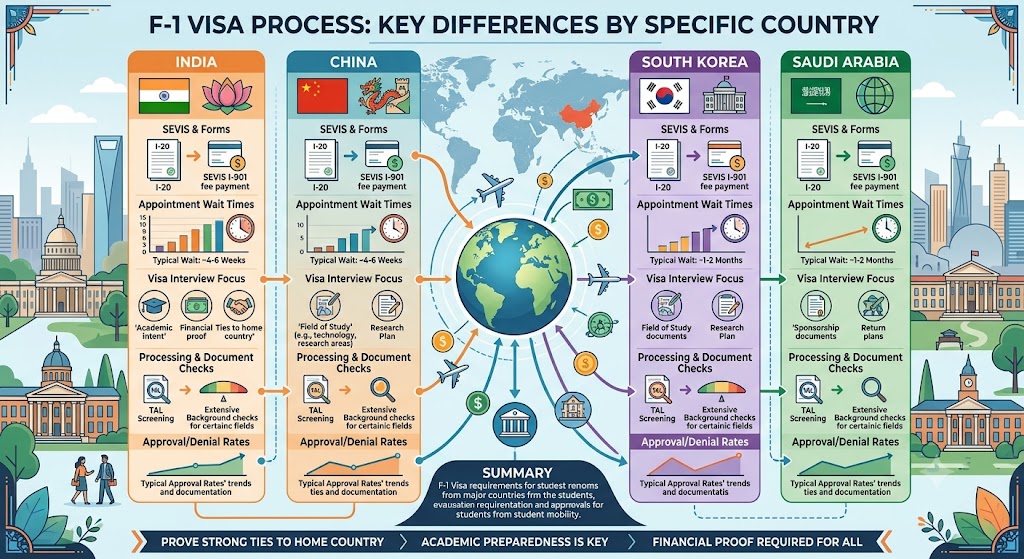
India
- Apply for your visa interview 4–6 months before your program start date — summer slots fill extremely fast
- Interview locations: New Delhi, Mumbai, Chennai, Kolkata, Hyderabad
- Strong home country ties to demonstrate: family, property, bank accounts, future job offers
- STEM OPT is particularly critical for Indian students — H-1B backlog for EB-2 India is currently 80+ years; STEM OPT buys time while pursuing alternative paths (O-1, EB-1A)
- Indian students are the largest international group at many Texas universities including UNT, UH, and UT Dallas
China
- Apply 3–5 months in advance — Beijing, Shanghai, Guangzhou, Chengdu, Shenyang consulates
- STEM OPT equally valuable — EB-2 China backlog is decades long
- Additional security clearances may apply for certain STEM fields — allow extra processing time
Mexico
- Apply 2–3 months in advance — Ciudad Juárez, Mexico City, Guadalajara, Monterrey, Tijuana, Mérida, Nogales consulates
- Good Neighbor Scholarship is specifically available at Texas public universities for qualifying Mexican students — contact the university’s financial aid office
- Mexico-Texas border proximity makes in-person consulate visits more accessible than for students from other countries
Nigeria
- Apply 5–6 months in advance — Lagos and Abuja consulates; appointments are extremely limited
- Strong financial documentation is especially important — officers scrutinize financial evidence carefully
Common F-1 Visa Mistakes to Avoid
| Mistake | Consequence | How to Avoid |
|---|---|---|
| Applying too late for interview appointment | Miss enrollment deadline | Book appointment 4–6 months early (India, Nigeria) |
| Paying SEVIS fee too early | Fee may not be linked to current I-20 | Pay after receiving I-20 and close to program start |
| 12+ months full-time CPT | Permanently lose OPT eligibility | Never exceed 11 months of full-time CPT |
| Dropping below full-time without DSO approval | Loss of F-1 status | Always consult DSO before dropping credits |
| Working off-campus without authorization | Deportation; future visa bans | Never work off-campus without EAD/CPT authorization |
| Letting I-20 expire | Loss of valid status | Request I-20 extension before expiry date |
| Not checking in with DSO within 3 days of arrival | SEVIS record cancelled | Report immediately upon arrival on campus |
| Mentioning immigration intent at interview | Visa denial (failure to maintain non-immigrant intent) | Never mention desire to permanently immigrate |
| Applying for OPT too late | Gap in work authorization | Apply 60–90 days before graduation; processing takes months |
F-2 Dependent Visa — Bringing Your Family
F-1 students can bring their spouse and unmarried children under 21 to the United States on F-2 dependent visas. Key details:
- F-2 holders cannot work in the United States — this is an absolute restriction
- F-2 holders can study part-time for recreational or avocational purposes
- Children on F-2 can attend K-12 school full-time
- The F-1 student must show sufficient financial support for dependents in addition to their own expenses
- F-2 visa is applied for separately by the dependent, using the F-1 student’s I-20 as supporting documentation
After F-1 — Long-Term U.S. Immigration Pathways
Many international students who study at Texas universities want to explore long-term U.S. immigration options after graduation. The most common pathways from F-1 include:
- H-1B Visa — employer-sponsored specialty occupation visa. 65,000 annual cap (plus 20,000 for U.S. master’s degree holders) with a lottery for oversubscribed cap. STEM OPT buys time while waiting for H-1B approval
- O-1 Visa — for individuals with extraordinary ability in science, business, education, or arts. No annual cap; increasingly used by Indian and Chinese students who face decades-long H-1B green card backlogs
- EB-1A (Extraordinary Ability Green Card) — for extraordinary ability in science, arts, education, business, or athletics. No employer sponsor required; no labor certification required. Best long-term path for high-achieving STEM graduates, particularly from India and China where EB-2 and EB-3 backlogs are decades long
- National Interest Waiver (NIW/EB-2) — for individuals whose work is in the national interest of the United States. Used by researchers, scientists, and highly skilled professionals
Texas Universities — Where to Get F-1 Visa Help
Every Texas university covered in this guide has a dedicated International Student Services office. These offices handle I-20 issuance, SEVIS maintenance, OPT/CPT authorization, and visa advising. Contact your target university’s international office as early as possible in the admission process:
- UT Austin — isss.utexas.edu
- Texas A&M — isss.tamu.edu
- University of North Texas — international.unt.edu
- UT Dallas — utdallas.edu/iss
- University of Houston — uh.edu/iss
- Texas Tech University — depts.ttu.edu/international
- Texas State University — txst.edu/isss
- Sam Houston State University — shsu.edu/international
- Lamar University — lamar.edu/international
- Tarleton State University — tarleton.edu/international
F-1 Visa Quick Reference Checklist
| Step | Action | Fee | Timing |
|---|---|---|---|
| 1 | Get admitted + request I-20 from university | Free | Allow 2–4 weeks after submitting financial docs |
| 2 | Pay SEVIS I-901 fee at fmjfee.com | $350 | After receiving I-20; at least 3 days before interview |
| 3 | Complete DS-160 at ceac.state.gov | Free | At least 48 hours before interview |
| 4 | Pay MRV visa application fee | $185 | Before scheduling interview appointment |
| 5 | Schedule visa interview at U.S. Embassy | Free | 4–6 months early (India/Nigeria); 2–3 months (others) |
| 6 | Prepare and organize all documents | — | 1–2 weeks before interview |
| 7 | Attend visa interview | — | On appointment date |
| 8 | Receive passport with visa stamp | — | 3 days to 3 weeks after interview |
| 9 | Enter U.S. (no earlier than 30 days before program start) | — | Within 30 days of program start |
| 10 | Report to International Office within 3 days | — | Immediately on arrival |
Final Thoughts
The F-1 visa process is manageable when you start early, follow the sequence correctly, and prepare thoroughly for your interview. The two most important actions are: apply for your visa interview appointment much earlier than you think you need to (especially from India, Nigeria, China, and Pakistan), and never accumulate 12+ months of full-time CPT — that single decision can permanently eliminate your OPT and STEM OPT eligibility.
For the most current fee amounts, processing times, and policy updates, always verify directly with the U.S. Embassy in your country (usembassy.gov) and with your Texas university’s International Student Services office. Immigration regulations can change — the information in this guide reflects policies as of 2026, but official sources should always be your final reference.
Have questions about the F-1 visa process for Texas universities? Drop them in the comments below — we’ll do our best to help.
Leave a Reply