The University of Texas at Austin (UT Austin) is the flagship public research university of Texas — ranked #30 nationally and #7 among public universities in the U.S. (US News 2026) with 55,000+ students from 130+ countries, a 26.6% overall acceptance rate (10% for out-of-state), and in-state tuition of approximately $13,506/year.
The Texas Advance Commitment (TAC) covers full tuition for Texas residents from families earning under $100,000 — and as of over 12,000 undergraduates attend UT Austin tuition-free. Here’s the complete breakdown.
What Is the University of Texas at Austin?
Founded in 1883, the University of Texas at Austin is the flagship institution of the University of Texas System — one of the largest university systems in the United States. UT Austin is consistently ranked among the top 30 national universities in the country and among the top 70 worldwide, and its research output, alumni influence, and program depth place it firmly in the tier of elite American public research universities alongside UCLA, University of Michigan, and UC Berkeley.
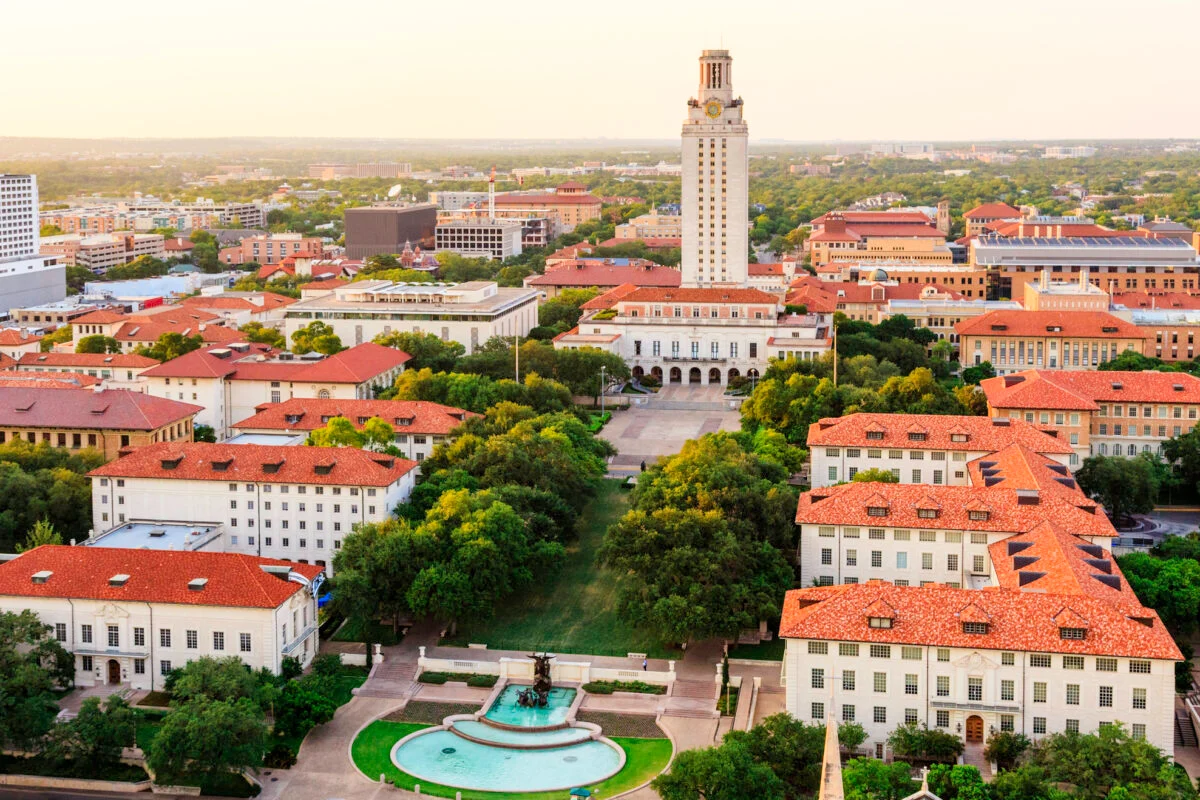
UT Austin’s 431-acre campus sits at the heart of Austin, Texas — directly adjacent to the Texas State Capitol and woven into the fabric of one of America’s most dynamic cities. With over 55,000 students enrolled across 18 colleges and schools, UT Austin is one of the largest universities in the country by enrollment, yet manages to maintain program quality and research output that smaller, more selective institutions aspire to match.
The university is classified as an R1 Doctoral University — Highest Research Activity by the Carnegie Classification, with annual research expenditures exceeding $700 million. Notable affiliated research facilities include the Texas Advanced Computing Center (TACC) — home to some of the most powerful supercomputers in the world — the Dell Medical School, and the Oden Institute for Computational Engineering and Sciences. UT Austin is also home to the Blanton Museum of Art and the Harry Ransom Center, two of the most significant cultural institutions in Austin.
UT Austin is fully accredited by SACSCOC, with over 200 individual program accreditations including AACSB (McCombs Business), ABET (engineering), ABA (law), and NAAB (architecture).
University of Texas at Austin — Key Facts
| Detail | Information |
|---|---|
| Founded | 1883 |
| Location | Austin, Texas (110 Inner Campus Drive, 78705) |
| University System | University of Texas System |
| Type | Public R1 Flagship Research University |
| Total Enrollment | 55,000+ students |
| Undergraduate | 44,000+ students |
| Graduate / Professional | 10,000+ students |
| International Students | 6,600+ from 130+ countries |
| Teaching Faculty | 3,000+ |
| Overall Acceptance Rate | ~26.6% |
| Out-of-State Acceptance Rate | ~10% |
| Transfer Acceptance Rate | ~22.5% |
| Average Admitted GPA | 3.8 (unweighted) |
| Average SAT (Admitted) | 1,355 |
| Average ACT (Admitted) | 32 |
| Campus Size | 431 acres |
| Annual Research Expenditure | $700+ million/year |
| In-State Tuition | ~$13,506/year |
| Out-of-State Tuition | ~$42,000–$51,106/year |
| International Tuition | ~$40,582–$48,712/year |
| US News Ranking (2026) | #30 National Universities; #7 Public Universities |
| QS World Ranking (2026) | #67 |
| Top 10 Ranked Programs | 45 graduate programs (US News) |
| Programs Ranked #1 | 4 programs (US News) |
| Students Attending Tuition-Free | 12,000+ |
| Athletics | NCAA Division I, SEC Conference |
| Mascot | Bevo the Longhorn |
| Accreditation | SACSCOC + 200+ program accreditations |
| Website | utexas.edu |
Programs and Schools at UT Austin
UT Austin offers over 170 undergraduate fields of study and 100+ graduate programs across 18 colleges and schools. 45 graduate programs are ranked in the Top 10 nationally by US News, including 4 programs ranked #1 in the country — a research distinction that rivals the Ivy League at a public university tuition price.
Most Prestigious Programs
Cockrell School of Engineering (ABET) — Consistently ranked among the top 10 engineering schools nationally. Programs in Electrical & Computer Engineering, Petroleum Engineering, Aerospace Engineering, Civil Engineering, Chemical Engineering, and Computer Science. The engineering school’s research output and industry connections — particularly with the Austin tech sector, energy companies, and defense contractors — make it one of the strongest career pathways in the country for engineering graduates.
McCombs School of Business (AACSB) — Ranked #18 nationally for Full-Time MBA (US News), #8 for Part-Time MBA. Undergraduate BBA programs are among the most competitive to enter at UT Austin. MBA average GMAT: 704; average work experience: 5.9 years; average GPA: 3.46. The McCombs Part-Time MBA is particularly valuable for working professionals in the Austin tech and business sectors. MBA placement rate: 80.2% within 6 months for the Class.
School of Law (ABA) — Ranked among the top 15 public law schools in the country. UT Law’s proximity to the Texas government, federal courts, and major law firms makes it one of the strongest pipelines into Texas legal careers.
LBJ School of Public Affairs — One of the top public policy schools in the United States, with direct connections to the Lyndon Baines Johnson Presidential Library on campus and a strong placement record in government, policy, and nonprofit sectors.
School of Information (iSchool) — Ranked #3 nationally for Information Studies (US News). MS in Information Studies (MSIS), MS in Data Science, and other information programs with strong tech-sector placement.
Moody College of Communication — Top-ranked journalism, advertising, film, and public relations programs. Austin’s media and entertainment sector gives Moody students real internship access.
College of Natural Sciences — Biology, Chemistry, Physics, Mathematics, Computer Science, Astronomy. Strong pre-medical track — UT Austin’s relationship with Dell Medical School and the broader Austin healthcare ecosystem benefits pre-health students significantly.
Programs Ranked #1 Nationally (US News)
- Petroleum Engineering
- Nuclear and Radiological Engineering
- Latin American History
- Mobile/Wireless Networks
Most Popular Programs for International Students
Computer Science, Electrical Engineering, Mechanical Engineering, Business Analytics, Information Studies, Finance, and MBA are the most enrolled programs for international graduate students. UT Austin’s CS and Engineering MS programs are among the most competitive to enter and among the highest-career-ROI graduate programs in Texas.
UT Austin Tuition and Cost of Attendance
| Student Type | Tuition & Fees | Total COA (Est.) |
|---|---|---|
| Texas Residents (Undergraduate) | ~$13,506/year | ~$34,000–$40,000/year |
| Out-of-State (Undergraduate) | ~$42,000–$51,106/year | ~$64,204–$72,916/year |
| International (Undergraduate) | ~$40,582–$48,712/year | ~$60,000–$70,000/year |
Graduate Tuition
| Student Type | Tuition & Fees |
|---|---|
| Texas Residents (Graduate) | ~$17,312–$19,786/year |
| Out-of-State / International (Graduate) | ~$25,720–$61,214/year (varies by program) |
Graduate tuition varies significantly by program and college. Engineering, CS, and MBA programs tend toward the higher end; humanities and social sciences toward the lower end. Always verify current rates at utexas.edu.
Cost of Living in Austin
Austin has grown into one of the more expensive cities in Texas over the past decade. Off-campus housing near UT Austin typically runs $1,200–$1,800/month for apartments, and overall monthly living expenses average approximately $1,500–$2,000 including housing, food, and transportation. This is significantly higher than the cost of living near smaller Texas universities — a real factor to account for when comparing UT Austin’s in-state tuition advantage against the higher cost of living in Austin versus cities like Lubbock, Huntsville, or Wichita Falls.
UT Austin Financial Aid — Texas Advance Commitment (TAC)
Texas Advance Commitment — 12,000+ Students Tuition-Free
The Texas Advance Commitment (TAC) is UT Austin’s most impactful financial aid program — and one of the most generous at any flagship public university in the country:
| Family Adjusted Gross Income | TAC Award |
|---|---|
| Under $65,000/year | Full tuition + fees covered |
| $65,001 – $100,000/year | Full tuition covered (announced) |
| Above $100,000/year | May still qualify for need-based aid — file FAFSA |
Key TAC details:
- As of 12,000+ UT Austin undergraduates attend tuition-free through the TAC.
- Available to Texas resident undergraduate students only — not available to out-of-state or international students
- Requires completing FAFSA each year.
- Applies to tuition and mandatory fees only — room, board, and personal expenses are not covered.
- Funded by UT’s endowment and ongoing alumni giving.
For Texas residents from qualifying income backgrounds, the TAC makes UT Austin — a top-30 national university — potentially more affordable than many Texas public universities once the full COA is considered.
Scholarships For International Students
International students at UT Austin face a different financial picture — the TAC is not available to them, and UT Austin is need-aware for international applicants. However, several scholarship opportunities exist:
- International Education Fee (IEF) Scholarship — Helps international students cover a portion of the mandatory International Education Fee charged to all non-resident students
- Iimura Peace Endowed Scholarship — For undergraduate international students demonstrating financial need and a commitment to promoting peace and understanding
- Jerry D. Wilcox Community Engagement Scholarship — For international students who have made significant contributions to their communities through service
- Departmental and College Scholarships — Many merit-based scholarships from individual colleges (McCombs, Cockrell, etc.) are open to all students, including international students
- Graduate Fellowships and Assistantships — Most competitive graduate programs offer Teaching Assistantships (TAs) and Research Assistantships (RAs) that include a tuition waiver and stipend — the most significant financial support available to international graduate students at UT Austin
For international students, pursuing Graduate TA or RA positions is the most impactful path to reducing costs at UT Austin. Contact your target department directly about assistantship availability before applying.
National Merit Scholarships
UT Austin awards competitive packages to National Merit Scholarship Finalists who designate UT Austin as their first choice. Contact the Office of Admissions for current award amounts — UT Austin participates in the National Merit program, but packages are less comprehensive than at some smaller private Texas universities.
UT Austin Acceptance Rate and Admission Requirements
UT Austin is one of the most selective public universities in Texas. Understanding the admission landscape is critical before applying:
| Applicant Type | Acceptance Rate |
|---|---|
| Overall | ~26.6% |
| Texas Residents | Higher than average (priority by state law) |
| Out-of-State (U.S.) | ~10% |
| Transfer Students | ~22.5% |
| First-Year Class (2026) | Record 90,690 applications received |
Auto-Admission: Top 6% Rule
Texas law requires UT Austin to automatically admit Texas residents who graduate in the top 6% of their accredited Texas high school class. This is not an option — it is a legal mandate. Students who rank in the top 6% are guaranteed admission to UT Austin. The threshold was lowered from top 10% to top 6% as UT Austin’s selectivity has increased.
Undergraduate Requirements
- Apply via ApplyTexas.org or Coalition for College
- Application fee: $90 (non-refundable; $200 for MBA)
- Test-required as of the 2026 cycle — UT Austin ended its test-optional policy. SAT or ACT scores are now required for all applicants
- Competitive admitted profile: GPA 3.8+, SAT 1355+, ACT 32+
- Short answer essays are required — UT Austin weighs essays heavily in holistic review
- English proficiency for international students: TOEFL iBT 80+, IELTS 6.5+
- International Financial Certificate required for international applicants
- Application deadlines:
- Early Action: October 15 (decisions by January 15)
- Regular Decision: December 1 (decisions by February 15)
- Spring: September 1
Graduate Requirements
- Apply through individual school portals — each college manages its own graduate admissions
- Application fees: $90 for most programs; $200 for MBA; $125 for MPA
- Minimum GPA of 3.0 for most graduate programs
- GRE/GMAT requirements vary by program (see table below)
- Letters of recommendation: typically 2–3
- Statement of purpose
- TOEFL iBT 80+, IELTS 6.5+ for international applicants
Popular Graduate Program Requirements
| Program | Test Requirement | Key Documents |
|---|---|---|
| MS Computer Science | GRE Score 316+ | 2 LORs, SOP, Resume |
| MS Electrical & Computer Engineering | Not required | SOP, LOR, Resume |
| MS Business Analytics | GMAT/GRE Optional | Transcripts, Essays, 3 LORs, Resume |
| MS Finance | GMAT/GRE Optional | Transcripts, Essay, 2 LORs, Resume |
| MS Information Studies | GRE Optional | SOP, 3 LORs, Resume |
| Full-Time MBA | GMAT 650–740 / GRE 156–165 | 1 LOR, Optional Statement, Resume |
| MS Civil Engineering | GRE may be required | 3 LORs, SOP, Resume |
| MS Engineering Management | GRE (waiver with 3.0+ GPA or 3 yrs experience) | 3 LORs, SOP, Resume |
Campus Life at UT Austin
The Forty Acres
UT Austin’s campus — known affectionately as “The Forty Acres” (its original 40-acre land grant) — is one of the most vibrant and culturally rich university campuses in the United States. With 55,000 students and over 1,200 student organizations, the range of campus life at UT Austin is virtually limitless. Academic clubs, Greek life, cultural organizations, professional societies, activist groups, intramural sports, performing arts companies, and religious organizations all operate at scale.
The Texas Union and the Student Activity Center serve as the primary social hubs. The LBJ Presidential Library, Blanton Museum of Art, and Harry Ransom Center (housing first editions, manuscripts, and cultural artifacts from across literary history) are all on campus — making UT Austin one of the culturally richest university campuses in the country.
The Tower and Campus Landmarks
The UT Tower — a 307-foot landmark at the center of campus — is one of the most recognized university buildings in America. The South Mall, Main Building, and surrounding plazas create an architectural core that generations of Longhorns have called home. The campus is dense and walkable; most students bike or walk between classes.
Athletics — Big Conference Move to SEC
The Texas Longhorns made one of the most significant athletic realignment moves in college sports history: leaving the Big 12 Conference for the Southeastern Conference (SEC). The SEC is widely considered the most competitive conference in college sports, and the Longhorns’ arrival brought national attention. The SEC move impacts recruiting, television revenue, and national profile in ways that will unfold over the coming years.
UT Austin’s Darrell K Royal–Texas Memorial Stadium seats over 100,000 fans — one of the largest stadiums in college football — and Longhorn game days in Austin are among the most electric in college sports. The Longhorns compete across 20 varsity sports including football, basketball, baseball, softball, swimming, track and field, tennis, and golf.
Notable UT Austin alumni: Michael Dell (founder of Dell Technologies, dropped out but returned to finish), Matthew McConaughey (actor, now Professor of Practice at UT), Laura Bush, Earl Campbell (NFL Hall of Fame), Roger Clemens (baseball), and hundreds of Fortune 500 executives, politicians, scientists, and artists.
Research and Career Outcomes
UT Austin’s research infrastructure is among the finest at any public university in the country:
- Texas Advanced Computing Center (TACC) — Operates some of the world’s most powerful academic supercomputers, supporting research in AI, climate science, genomics, and engineering simulation
- Dell Medical School — Opened 2016; integrating medical education with Austin’s healthcare ecosystem and pioneering value-based healthcare delivery models
- Oden Institute for Computational Engineering and Sciences — Leading research in mathematical modeling and simulation
- Energy Institute — Research across renewable energy, grid modernization, and energy policy
- IC2 Institute — Technology commercialization and entrepreneurship research
Career placement from UT Austin reflects the university’s program strength and Austin’s job market:
- MBA placement rate: 80.2% within 6 months; top industries: consulting, financial services, energy, technology
- Engineering and CS graduates enter Austin’s tech sector with exceptional starting salaries — major recruiters include Apple, Google, Amazon, Dell, Oracle, Tesla, and hundreds of Austin-based startups.
- Total COA for international students is approximately $60,000–$70,000/year, but STEM OPT authorization gives international graduates up to 36 months of U.S. work authorization post-graduation — extending the return on investment significantly.
How UT Austin Compares to Other Texas Universities
- For a prestigious private R1 in Dallas with smaller class sizes and lower out-of-state tuition, see Southern Methodist University (SMU)
- For a private #72-nationally ranked university in Fort Worth with Big 12 athletics and 70% debt-free graduation, see Texas Christian University (TCU)
- For the #17-nationally ranked private university in Houston with the most generous need-based aid in Texas, see Rice University.
- For a large public R1 in Houston with lower tuition and access to NASA and the energy sector, see University of Houston.
- For a large public R1 near Dallas with automatic merit scholarships and in-state tuition waivers for international students, see University of North Texas.
- For a full comparison of Texas university scholarship options, see Texas Universities with Full Scholarships.
Is UT Austin Right for You?
UT Austin is a strong fit if you:
- Are a high-achieving Texas resident — particularly in the top 6% of your class, which guarantees admission
- Are pursuing engineering, computer science, business, law, public policy, information science, or natural sciences at a top-ranked program
- Are a Texas resident from a family earning under $100,000 who can benefit from the Texas Advance Commitment covering full tuition
- Want the scale, resources, and alumni network of a major flagship research university in Austin.n
- Are an international graduate student who can secure a TA or RA position — which providesa tuition waiver and stipend
- Want SEC athletics, 1,200+ student organizations, and Austin’s cultural and career ecosystem as part of your university experience
UT Austin is significantly more challenging for out-of-state and international undergraduate applicants (10% acceptance rate), and significantly more expensive without financial aid ($60,000–$70,000/year COA for international students).
The large student body — 55,000 students — means some students feel like a small fish in a very large pond, particularly in the first year before finding their community. Changing majors into competitive programs (McCombs, Cockrell, Moody) after initial enrollment is genuinely difficult and should be planned for carefully.
How to Apply to University of Texas at Austin
- Apply via ApplyTexas.org or Coalition for College — select University of Texas at Austin.
- Pay the $90 application fee ($200 for MBA; $125 for MPA).
- Apply by October 15 for Early Action (recommended) or December 1 for Regular Decision.
- Submit SAT or ACT scores — UT Austin ended its test-optional policy in 2026; scores are now required.
- Complete all required short answer essays — UT Austin’s essays are heavily weighted in holistic review.
- Submit English proficiency scores: TOEFL iBT 80+ or IELTS 6.5+ for international applicants.
- File FAFSA to access Texas Advance Commitment and all need-based aid (Texas residents).
- Submit International Financial Certificate demonstrating ability to cover educational costs (international students).
- Receive I-20 from the International Student and Scholar Services (ISSS) office after admission.
- Apply for F-1 student visa — allow 2–3 months minimum for processing.
- For graduate applicants: apply directly through your target college/department portal, and contact the department about TA/RA assistantship availability before applying.
Final Thoughts
The University of Texas at Austin is, by almost any measure, the most academically powerful public university in Texas. Its 45 top-10-ranked graduate programs, $700 million in annual research expenditure, flagship status in the UT System, and Austin location combine to create an institution that genuinely competes with the country’s best universities.
For Texas residents — particularly those from families who qualify for the Texas Advance Commitment — UT Austin may be the single best higher education value in the state. For out-of-state and international students, the lower acceptance rate and higher cost require more careful planning, but the STEM OPT pathway, TA/RA opportunities, and Austin’s career market make the investment defensible for the right student in the right program.
For current tuition, scholarship details, and application requirements, visit utexas.edu directly.
Have questions about UT Austin or comparing it with other Texas universities? Drop them in the comments below.
Leave a Reply