Texas vs New York Universities are the two most internationally diverse education destinations in the United States after California — and they represent two radically different approaches to what studying in America looks like. New York hosts over 135,000 international students.
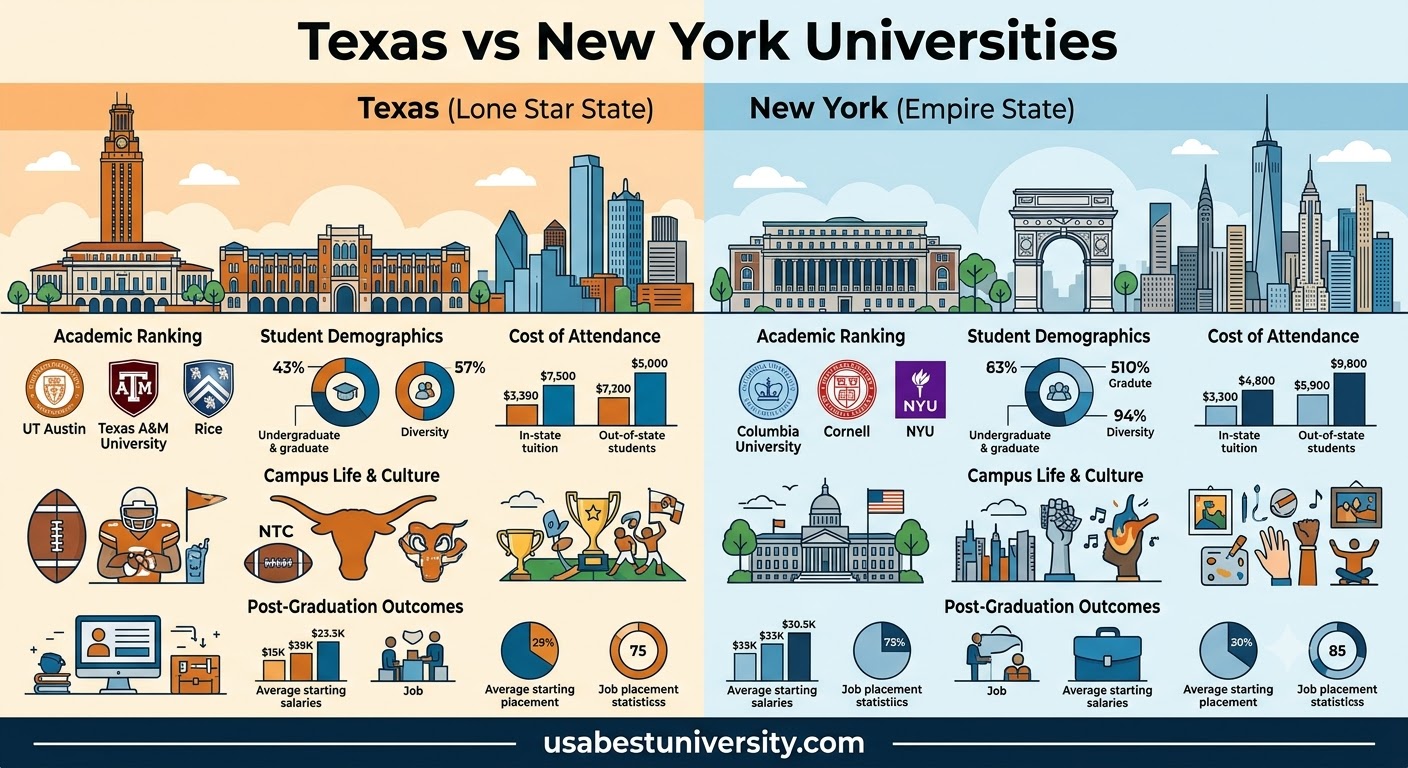
Texas hosts over 85,000. Both states have world-class research universities, vibrant international student communities, and strong post-graduation job markets. But the daily experience — the cost, the culture, the career sector, the quality of life — could not be more different. This guide gives you the honest, data-driven comparison you need to decide which state actually fits your goals.
Quick Comparison — Texas vs New York for International Students 2026
| Factor | Texas | New York |
|---|---|---|
| International Students | 85,000+ | 135,000+ |
| State Income Tax | 0% | 4%–10.9% |
| NYC Rent (near university) | N/A | $2,500–$5,000+/month |
| Texas Major City Rent | $800–$1,600/month | N/A |
| Top Public University Rank | UT Austin (#30) | SUNY Stony Brook (#93) |
| Top Private University Rank | Rice (#17) | Columbia (#12) |
| Public Intl Tuition (flagship) | ~$40,582 (UT Austin) | ~$32,700–$37,100 (SUNY) |
| SUNY/CUNY Affordable Option | N/A | $7,000–$18,000/yr (CUNY) |
| Scholarship Access (Intl) | High — automatic merit waivers | Limited at public; better at private |
| Finance/Wall Street Access | Growing (Dallas) | Unmatched — global #1 |
| Tech Job Market | Austin + DFW growing rapidly | NYC tech growing but smaller than Bay Area |
| Energy Job Market | Houston = world #1 | Very limited |
| No Income Tax Benefit | ✅ Zero state income tax | ❌ Up to 10.9% state + NYC city tax |
| Indian Community | DFW #3 metro US | NYC/NJ #1 metro US |
| Cost of Living vs National Avg | 10–15% below average | NYC: 130%+ above average |
| Weather | Hot summers, mild winters | Cold winters, humid summers |
| STEM OPT | ✅ 36 months | ✅ 36 months |
1. Cost — Texas vs New York Is Not a Close Contest
The cost difference between studying in Texas and New York City is the single most important factor for most international students — and it is enormous.
Tuition Comparison
| University | State | Intl Tuition/yr (2026) |
|---|---|---|
| Columbia University | New York | ~$68,000+ |
| NYU (New York University) | New York | ~$60,000–$65,000 |
| Cornell University (Ivy) | New York | ~$64,000+ |
| Fordham University | New York | ~$56,000 |
| SUNY Stony Brook | New York | ~$32,700–$37,100 |
| SUNY Buffalo | New York | ~$31,000–$35,000 |
| CUNY (City University of NY) | New York | ~$7,000–$18,000 |
| UT Austin | Texas | ~$40,582–$48,712 |
| Texas A&M | Texas | ~$40,124 (before waiver) |
| Rice University | Texas | ~$65,475 |
| UNT (with scholarship) | Texas | ~$13,506 |
| UT Dallas (with AES) | Texas | ~$14,644 |
At the private flagship level, New York’s Columbia and Cornell are more expensive than Rice University — Texas’s most elite private institution. At the public flagship level, SUNY schools are cheaper than UT Austin in tuition — but the living cost gap more than erases that advantage for anyone studying in New York City.
Living Cost — The Real Game Changer
Add $18,000–$30,000 per year for living expenses, with New York City at the top of that range and upstate cities much cheaper. For context:
| City | Avg Monthly Rent (1BR) | Monthly Total Living | Annual Living Cost |
|---|---|---|---|
| New York City (Manhattan) | $3,500–$5,000+ | $4,500–$6,500 | $54,000–$78,000 |
| New York City (Brooklyn/Queens) | $2,500–$3,800 | $3,500–$5,000 | $42,000–$60,000 |
| Buffalo (SUNY Buffalo) | $800–$1,200 | $1,400–$1,900 | $16,800–$22,800 |
| Stony Brook (SUNY Stony Brook) | $1,200–$2,000 | $1,800–$2,600 | $21,600–$31,200 |
| Austin (UT Austin) | $1,200–$1,600 | $1,800–$2,200 | $21,600–$26,400 |
| College Station (TAMU) | $800–$1,100 | $1,400–$1,800 | $16,800–$21,600 |
| Richardson/Dallas (UTD) | $800–$1,200 | $1,400–$1,800 | $16,800–$21,600 |
| Houston (UH) | $900–$1,400 | $1,500–$2,000 | $18,000–$24,000 |
New York is fast-paced and highly dense, with a strong career-driven culture that prioritizes ambition, networking, and constant movement. That energy comes with a price: in cities like New York or Los Angeles, living costs are significantly higher than average. A student at NYU or Columbia in Manhattan typically spends $4,500–$6,500/month on living alone — more than the annual tuition at some Texas universities.
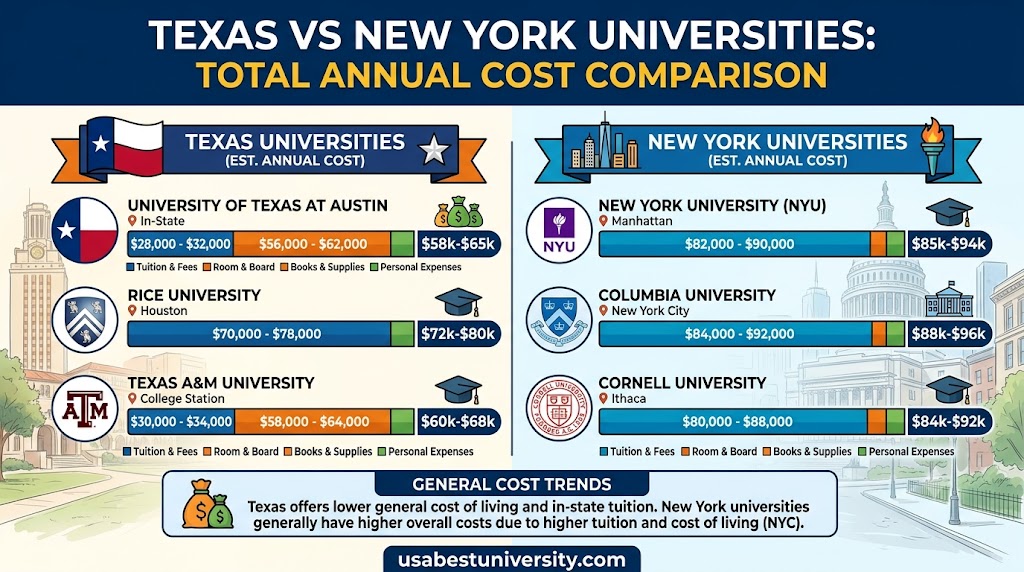
Total Annual Cost Comparison
| Scenario | Annual Total Cost | 2-yr MS Total (est.) |
|---|---|---|
| NYU (Manhattan, private) | $85,000–$110,000 | ₹142–184 lakhs |
| Columbia (Manhattan, Ivy) | $95,000–$120,000 | ₹159–201 lakhs |
| SUNY Stony Brook (commute/on-campus) | $55,000–$70,000 | ₹92–117 lakhs |
| SUNY Buffalo (affordable NY) | $48,000–$58,000 | ₹80–97 lakhs |
| UT Austin (Texas) | $60,000–$72,000 | ₹100–120 lakhs |
| TAMU (with $4K waiver) | $28,000–$36,000 | ₹47–60 lakhs |
| UTD (with AES scholarship) | $32,000–$40,000 | ₹54–67 lakhs |
| UNT (with Excellence Scholarship) | $28,000–$35,000 | ₹47–59 lakhs |
INR estimates at approximately ₹84/USD. Add ₹1–2 lakhs for international travel, health insurance, and incidentals.
State Income Tax — An Often-Ignored Advantage
Texas has zero state income tax. New York State charges 4%–10.9% — and New York City adds 3.078%–3.876% city income tax on top of that. A student working in New York City during OPT and earning $100,000 may pay $13,000–$15,000/year in state and city income taxes alone.
The same student working in Austin pays zero. Over a 3-year STEM OPT period, that difference amounts to $39,000–$45,000 — equivalent to nearly an entire year of tuition at a Texas university.
2. University Rankings — New York’s Private Institutions Lead at the Top
| University | State | US News 2026 Rank | QS World 2026 |
|---|---|---|---|
| Columbia University | New York | #12 | #33 |
| Cornell University | New York | #13 | #13 |
| Rice University | Texas | #17 | #122 |
| NYU | New York | #35 | #58 |
| UT Austin | Texas | #30 | #67 |
| SMU | Texas | #61 | — |
| Fordham University | New York | #68 | — |
| Rensselaer Polytechnic (RPI) | New York | #53 | — |
| Texas A&M | Texas | #51 | #169 |
| SUNY Stony Brook | New York | #93 | #341 |
| Baylor University | Texas | #91 | — |
| SUNY Buffalo | New York | #94 | #601–650 |
| University of Houston | Texas | #144 | ~#600 |
| CUNY (system avg) | New York | Varies | — |
At the very top, New York wins — Columbia (#12) and Cornell (#13) are Ivy League institutions that Texas simply cannot match. But below the Ivy tier, Texas and New York are broadly comparable: UT Austin (#30) outranks NYU (#35), and Texas A&M (#51) is close to RPI (#53) and above SUNY Stony Brook (#93). At the affordable public university level, SUNY Buffalo (#94) and Texas A&M System universities are in the same tier.
Key insight: For students who are not targeting Columbia or Cornell specifically, the ranking premium of studying in New York is smaller than the cost premium. NYU (#35) costs $85,000–$110,000/year all-in. UT Austin (#30) costs $60,000–$72,000/year all-in. UT Austin is ranked higher than NYU and costs $25,000–$38,000 less per year.
3. Best New York Universities for International Students
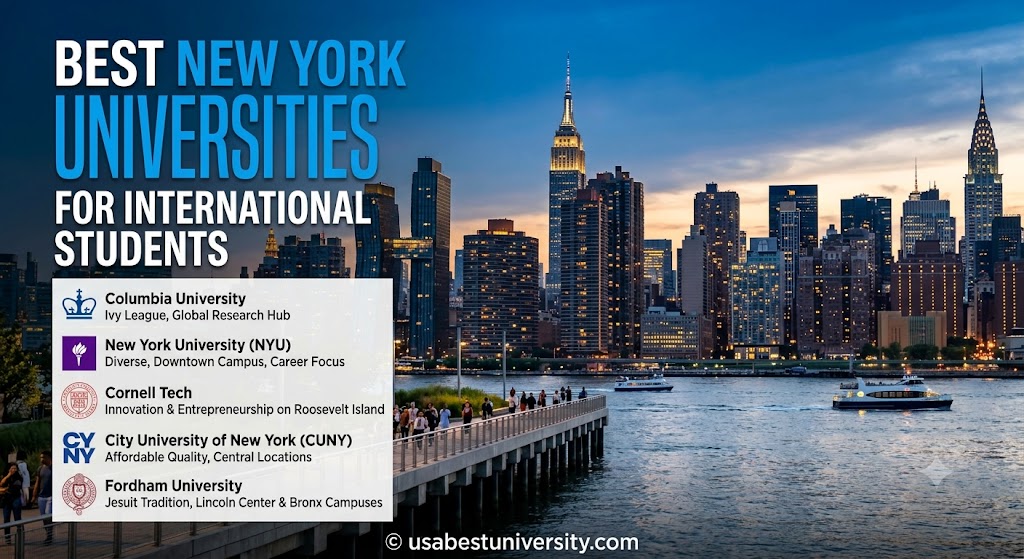
Understanding New York’s university landscape is essential before comparing it to Texas:
Ivy League / Elite Private
- Columbia University — Manhattan; #12 nationally; ~4% acceptance rate; ~$68,000+ tuition; need-blind for international students (rare and valuable); world-leading finance, journalism, and social science programs
- Cornell University — Ithaca (upstate NY); #13 nationally; ~8% acceptance rate; ~$64,000+ tuition; strongest engineering, hotel management, and agriculture programs among Ivies; Ithaca’s cost of living is significantly lower than NYC
Large Urban Research Universities
- NYU (New York University) — Manhattan; #35 nationally; ~12% acceptance rate; ~$60,000–$65,000 tuition; Stern School of Business (#20 MBA), Tisch School of Arts; campus is embedded in NYC with no traditional campus boundary
- Fordham University — Bronx + Lincoln Center (Manhattan); #68 nationally; ~48% acceptance; ~$56,000 tuition; Gabelli School of Business; Jesuit-affiliated; strong law and business programs
- Rensselaer Polytechnic Institute (RPI) — Troy; #53 nationally; ~51% acceptance; strong engineering and CS programs; lower cost of living than NYC
SUNY System — Best Public Value in New York
- SUNY Stony Brook — Long Island; #93 nationally; R1 research; ~$32,700–$37,100 international tuition; strong STEM programs; New York hosts more than 135,000 international students — the second-highest of any US state
- SUNY Buffalo — Buffalo (upstate NY); #94 nationally; R1 research; ~$31,000–$35,000 international tuition; Buffalo’s cost of living is among the lowest in the northeastern U.S.; strong engineering and pharmacy programs
- SUNY Binghamton — Binghamton; ranked #80 nationally; R2 research; strong business school (School of Management); lower cost of living than NYC
CUNY System — Most Affordable in New York
- CUNY (City University of New York) — Multiple campuses across NYC; a public system that charges internationals as little as $7,000–$18,000 a year; CUNY Baruch College (finance, business) and CUNY City College (engineering) are the strongest academically; full NYC career access at dramatically lower tuition than private alternatives
4. Job Market — Finance vs Energy vs Tech
New York’s Unmatched Finance and Media Advantage
New York City’s job market has one sector that is simply not replicated anywhere in the United States — including Texas: Wall Street finance. JPMorgan Chase, Goldman Sachs, Morgan Stanley, Citigroup, BlackRock, Bloomberg — all headquartered in New York City. For students targeting investment banking, asset management, hedge funds, private equity, or financial consulting, proximity to New York City is a genuine, structural advantage that goes beyond networking — it is geography that determines access to the most coveted finance roles in the world.
New York also leads in:
- Media, entertainment, and publishing — NBCUniversal, ViacomCBS, Condé Nast, The New York Times, Penguin Random House
- Fashion and luxury — LVMH, Kering, Ralph Lauren, Tapestry
- Consulting — McKinsey, BCG, Bain, Deloitte, PwC, EY all have major NYC offices
- Healthcare and biotech — Pfizer, Johnson & Johnson, and a growing biotech corridor in Brooklyn and the Hudson Valley
Texas’s Industry Strengths That New York Cannot Match
- Energy (Houston) — ExxonMobil, Shell, Chevron, Halliburton, Schlumberger. New York has virtually no petroleum engineering or energy management industry. If energy is your career, Texas is the only answer.
- Technology (Austin + DFW) — Apple, Dell, Oracle, Tesla, Google, Amazon (Austin); AT&T, Samsung, Ericsson, Texas Instruments (DFW). Austin’s tech sector is growing faster than NYC’s and with lower operating costs.s
- Aerospace and Defense — Lockheed Martin, Bell Textron, NASA. Texas’s defense-aerospace cluster is among the strongest in the country; New York has limited aerospace presence.ce
- No State Income Tax — on a $100,000 OPT or post-graduation salary, Texas employees take home $13,000–$15,000 more annually than equivalent New York City workers after state and city taxes
Career Verdict
| Career Target | Better State | Why |
|---|---|---|
| Investment banking/finance | New York | Wall Street — no real competition |
| Media/entertainment/fashion | New York | NYC dominates all three |
| Petroleum/energy engineering | Texas | Houston = world energy capital |
| Technology (software/hardware) | Texas (growing) or NY (established) | Austin/DFW faster growth; NYC deeper network |
| Consulting (top-tier firms) | Comparable | Both states have major offices |
| Healthcare management | Comparable | Texas Medical Center vs NYC hospital systems |
| Aerospace/defense | Texas | Lockheed Martin, Bell, NASA in Texas |
| Entrepreneurship/startups | Texas (Austin) | Lower costs, no income tax, VC growing |
5. Scholarship Accessibility — Texas Wins for International Students
New York — Limited Public Scholarships for International Students
- SUNY and CUNY campuses offer very limited merit scholarships for international students — most state-funded aid is restricted to New York residents or U.S. citizens
- Columbia is need-blind for international students — one of only a handful of U.S. universities with this policy — and meets 100% of demonstrated need. For admitted students, Columbia can be surprisingly affordable regardless of family income
- Cornell is need-aware for international students and offers need-based financial aid
- NYU offers limited merit scholarships for international students — the university is known more for its prestige than its generosity with aid
- Fordham and other mid-tier private New York universities offer merit scholarships ranging from $5,000–$25,000/year
Texas — Multiple Automatic Pathways to Reduced Tuition
- UT Dallas AES — any level automatically unlocks in-state tuition ($14,644 vs $40,000+) — apply by December 1
- UNT Excellence Scholarship — automatic by March 1; any tier unlocks in-state tuition
- Texas A&M $4,000 waiver — competitive scholarships totaling $4,000 unlock in-state rates
- Texas Tech Presidential Scholarship — automatic; unlocks in-state tuition
- Lamar University auto grad waiver — most international graduate students receive out-of-state tuition waiver automatically
- Good Neighbor Scholarship — full non-resident tuition exemption for qualifying Western Hemisphere nationals at all Texas public universities
The contrast is stark: at UT Dallas with AES, an Indian MS student pays approximately $14,644/year in tuition. At SUNY Stony Brook — New York’s best affordable public option — the same student pays $32,700–$37,100/year in tuition, plus significantly higher living costs in the NYC metro area. For most international students, Texas’s scholarship mechanisms provide dramatically better financial access to comparable-quality education.
6. Indian and South Asian Community — New York Leads, Texas Close Behind
New York — Largest South Asian Community on the East Coast
- New York/New Jersey metro is the #1 U.S. metro for Indian-origin residents by total population — approximately 700,000 Indian Americans in the NYC metro area
- Jackson Heights (Queens) — called “Little India” and “Little Bangladesh” — is one of the most internationally diverse neighborhoods in the world
- Edison, NJ (30 minutes from NYC) has a massive South Asian community center — Indian grocery stores, temples, restaurants, and cultural organizations on every block
- Significant Gujarati, Punjabi, Telugu, Tamil, and Bengali communities across the five boroughs and the tri-state area
Texas — The Fastest-Growing South Asian Hub in the South
- DFW metro is the #3 U.S. metro for Indian-origin professionals and growing faster than New York’s Indian community as tech company relocations continue
- Irving — called the “Telugu capital of America” — has 8,360 Telugu speakers; Plano, Richardson, and Frisco have dense South Asian communities
- Houston’s Hillcroft Avenue “Little India” corridor, Sri Meenakshi Temple (Pearland — one of the largest Hindu temples in the U.S.), and multiple South Indian community organizations
- In more established states like California and New York, students often find large, international communities with deep-rooted cultural networks. While expansive, these environments can also feel more fragmented and competitive to navigate. Texas’s Indian communities — particularly in DFW — are large enough to be practically supportive but tight-knit enough to be personally meaningful.
7. Quality of Life — A Genuine Tradeoff
| Factor | Texas | New York |
|---|---|---|
| City Energy | Austin, Houston, Dallas — vibrant but manageable | NYC — world’s most electric city |
| Space per Dollar | Excellent — large apartments affordable | Very poor in NYC; better upstate |
| Public Transit | Car-dependent in most cities | NYC subway — excellent |
| Cultural Access | Growing arts, music, food scenes | World-class museums, Broadway, galleries |
| Weather | Hot summers, very mild winters | Cold winters (-10°C), humid summers |
| Outdoor Recreation | Hill Country, Gulf Coast, Big Bend | Central Park, Catskills, Hamptons |
| Safety | Varies by city and neighborhood | Varies significantly by NYC neighborhood |
| Pace of Life | More relaxed | Intense, fast-paced, ambitious |
| Diversity | Growing rapidly | Among the world’s most diverse cities |
New York is fast-paced and highly dense, with a strong career-driven culture that prioritizes ambition, networking, and constant movement. For students who thrive in that environment, New York City is genuinely transformative. For students who find the density and pace overwhelming — or who cannot absorb the cost — Texas offers a version of American university life that is more spacious, more affordable, and increasingly competitive professionally.
Head-to-Head: Texas vs New York at the Same Level
UT Austin (#30) vs NYU (#35)
| Factor | UT Austin | NYU |
|---|---|---|
| US News Rank | #30 | #35 |
| International Tuition | ~$40,582–$48,712 | ~$60,000–$65,000 |
| Annual Living Cost | ~$21,600–$26,400 | ~$42,000–$60,000 (Manhattan) |
| Total Annual Cost | ~$60,000–$72,000 | ~$100,000–$125,000 |
| 2-yr MS Total | ~₹100–120 lakhs | ~₹168–209 lakhs |
| Acceptance Rate | ~22.2% | ~12% |
| Finance Career Access | Growing (Austin) | Wall Street proximity |
| Tech Career Access | Apple, Dell, Google nearby | NYC tech (growing) |
Texas A&M (#51) vs SUNY Stony Brook (#93)
| Factor | Texas A&M | SUNY Stony Brook |
|---|---|---|
| US News Rank | #51 | #93 |
| International Tuition | ~$40,124 (before waiver) | ~$32,700–$37,100 |
| Tuition with Scholarship | ~$12,995 (with $4K waiver) | Limited international scholarships |
| Annual Living Cost | ~$16,800–$21,600 | ~$21,600–$31,200 |
| Alumni Network | 500,000+ (strongest in Texas) | Smaller |
UTD with AES vs CUNY Baruch
| Factor | UT Dallas (with AES) | CUNY Baruch |
|---|---|---|
| Annual Tuition | ~$14,644 | ~$7,000–$18,000 |
| Annual Living Cost | ~$16,800–$21,600 | ~$36,000–$54,000 (NYC) |
| Total Annual Cost | ~$32,000–$40,000 | ~$43,000–$72,000 |
| AACSB Business School | ✅ Jindal School | ✅ Zicklin School |
| Tech Sector Access | Telecom Corridor (on campus) | NYC tech (commute) |
| Finance Sector Access | Growing DFW | Wall Street (direct) |
Who Should Choose Texas?
- You are pursuing engineering, technology, or energy careers — Texas’s industry access is unmatched for these sectors
- You need to manage costs and are targeting a total annual budget under $50,000 — Texas scholarship mechanisms can bring this within reach
- You want no state income tax on your OPT or post-graduation salary
- You are targeting Texas-based companies where the Aggie Network, UTD’s Telecom Corridor, or UH’s energy sector connections give direct access
- You prefer a more spacious, affordable quality of life with lower cost per square foot of living space and lower daily expenses
- You are an Indian student specifically targeting DFW’s Telugu/Tamil community infrastructure or Houston’s South Indian community
Who Should Choose New York?
- You are targeting investment banking, asset management, or Wall Street finance careers — New York’s proximity to financial institutions is an irreplaceable structural advantage.e
- You have been admitted to Columbia or Cornell — the Ivy League prestige and alumni networks justify the premium for specific career trajectories.
- You are pursuing media, fashion, entertainment, or publishing careers where physical proximity to NYC’s industry hubs matters.
- You want the most culturally immersive, internationally diverse urban experience in American higher education — New York City is genuinely unlike anywhere else.
- You qualify for Columbia’s need-blind international admission — which can make Columbia more affordable than you expect
- You can afford the significantly higher cost of living without it creating unmanageable financial pressure. re
Final Thoughts
Texas and New York offer genuinely different versions of American higher education — and neither is universally better. For finance and media careers, New York’s structural advantages are real and significant. For energy, technology, and aerospace careers, Texas’s industry access is unmatched. For students managing budgets carefully, Texas’s scholarship mechanisms, lower cost of living, and zero state income tax create a financial picture that is dramatically more favorable than anything New York — outside of the CUNY system — can offer.
The honest comparison: for most international students in STEM and business fields who are not specifically targeting Wall Street, Texas offers a better financial return on the investment in education. For students who can access Columbia’s need-blind admission or whose career targets are genuinely Wall Street-specific, New York justifies its premium.
For complete guides on Texas universities, see:
- 10 Cheapest Texas Universities for International Students
- Texas Universities with Full Scholarships 2026
- Best Texas Universities for Indian Students 2026–27
- Texas vs California Universities 2026
- F-1 Student Visa Guide for Texas Universities 2026
Deciding between Texas and New York for your studies? Tell us your program, budget, and career goals in the comments — we’ll give you our honest take.
Leave a Reply