Best Universities In USA

  • Home
  • About Us
  • Contact Us
  • Privacy Policy
  • Disclaimer
  • USA University

Houston Baptist University – Tuition, Programs & Admissions

July 2, 2026 Leave a Comment

Houston Baptist University (HBU) — now officially renamed Houston Christian University (HCU) — is a private Christian university in Houston, Texas, with 4,276 students, an 84% acceptance rate, and tuition of approximately $39,100/year.

Houston Baptist University

100% of incoming freshmen receive financial aid averaging $24,996, merit scholarships are awarded automatically at admission, and the university’s location in the fourth-largest U.S. city gives students internship and career access that no other university on this site can match. Here’s everything you need to know.

What Is Houston Baptist University?

Founded in 1960 by the Baptist General Convention of Texas, Houston Baptist University spent its first six decades building a reputation as a faith-centered liberal arts institution in one of America’s largest cities. The university took a significant step — rebranding as Houston Christian University (HCU) to reflect a broader Christian identity that extends beyond its Baptist roots and better represents the diverse Christian community it serves. Throughout this guide, we use both names (HBU and HCU) since the university is still widely searched under both.

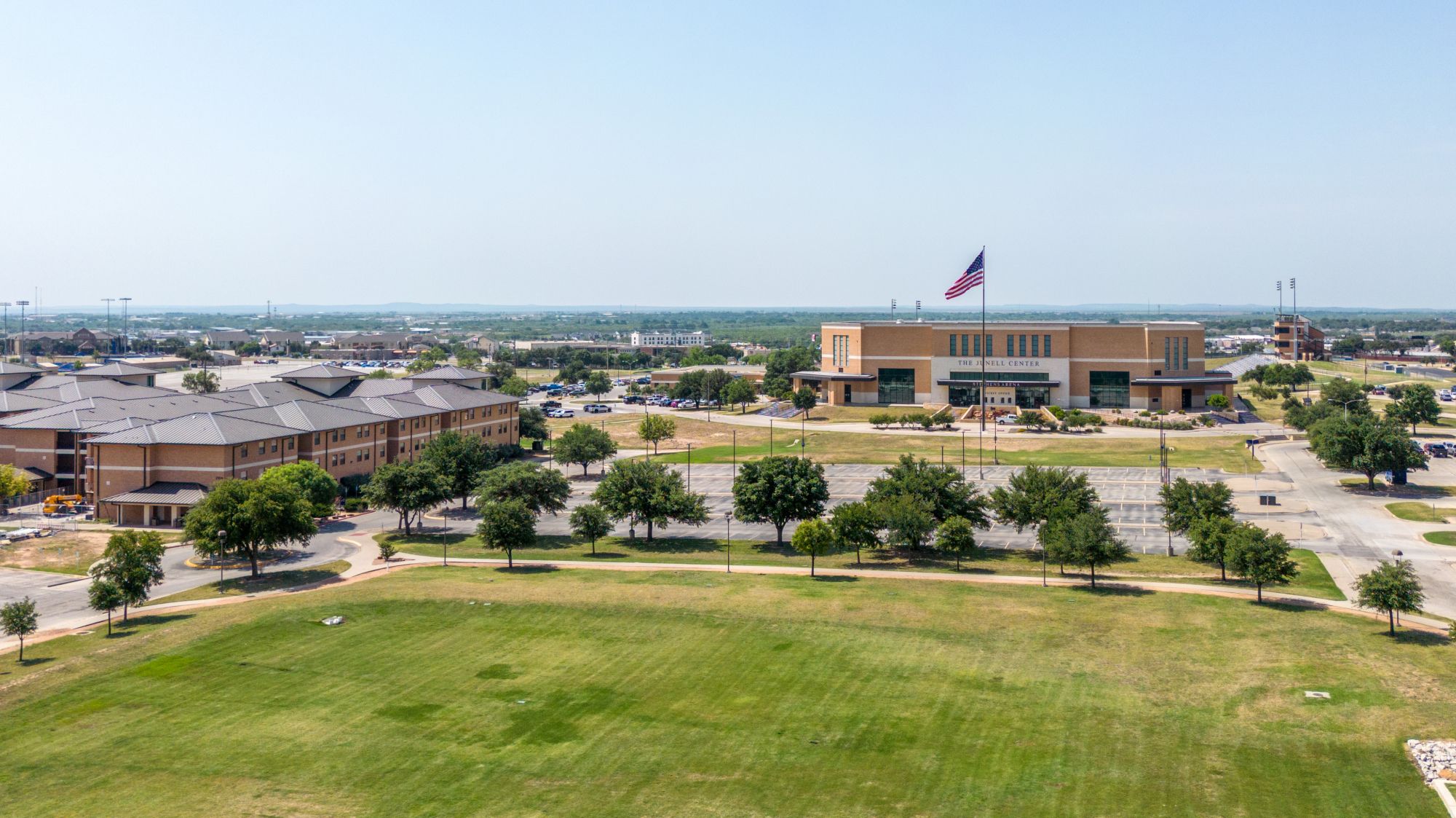
HCU operates from a 100-acre campus at 7502 Fondren Road in southwestern Houston — inside the Sam Houston Tollway loop, with convenient access to the Galleria, the Texas Medical Center, and the broader Houston metro. The campus features a distinctive mix of modern and colonial-style architecture, with the Hinton Center serving as the recognizable campus landmark. It operates as a primarily residential campus, though many students — given Houston’s size — commute from across the greater metro area.

HCU’s mission is built around the integration of faith and learning. Students are encouraged to engage in Christ-centered community and spiritual formation as part of the academic experience — but the university welcomes students from diverse backgrounds, and its programs in nursing, business, education, and the liberal arts are evaluated on their academic merit alongside their faith context.

HCU is accredited by SACSCOC, with program-level accreditations from ACBSP (business) and NLNAC/ACEN (nursing), among others.

Houston Baptist University at a Glance — Key Facts

DetailInformation
 Founded 1960
 Current Legal Name Houston Christian University (HCU)
 Common Name Houston Baptist University (HBU)
 Location Houston, Texas (7502 Fondren Road)
 Affiliation Baptist General Convention of Texas (Christian)
 Type Private Christian University
 Total Enrollment ~4,276 students
 Acceptance Rate ~84%
 Student-to-Faculty Ratio 15:1
 Campus Size 100 acres
 Tuition & Fees ~$39,100/year
 Average Net Price ~$20,057–$21,282/year
 Avg. First-Year Aid Package $24,996
 Median Graduate Salary (6 yrs) ~$45,000+
 Athletics NCAA Division I, Southland Conference
 Mascot Huskies
 Accreditation SACSCOC, ACBSP, NLNAC/ACEN
 Website hbu.edu

Programs and Schools at Houston Baptist University

HBU offers 76 undergraduate majors and 9 pre-professional programs through eight schools or colleges, along with graduate and doctoral programs across business, education, ministry, nursing, and behavioral sciences. The breadth of the academic catalog — 56 bachelor’s degree programs, 30 master’s programs, and 3 doctoral programs — is notable for a university of HBU’s size.

The eight academic colleges include:

  • School of Business
  • School of Education
  • School of Nursing
  • School of Christian Thought (Theology and Ministry)
  • School of Humanities
  • School of Natural Sciences and Mathematics
  • School of Behavioral Sciences
  • School of Fine Arts

Nursing — HBU’s Most In-Demand Program

Nursing is the most popular undergraduate major at HBU by enrollment. The Bachelor of Science in Nursing (BSN) is NLNAC/ACEN-accredited and places graduates directly into one of the most robust healthcare job markets in the United States.

Houston is home to the Texas Medical Center — the largest medical complex in the world, with 60+ institutions including MD Anderson Cancer Center, Houston Methodist, Texas Children’s Hospital, and Memorial Hermann. HBU nursing graduates have internship and employment access to this ecosystem in a way that nursing programs anywhere else in the country simply cannot replicate.

Graduate nursing options include a Master of Science in Nursing (MSN) with specializations in nursing education and nursing leadership, available both on campus and online. For students interested in advanced nursing practice, HBU’s Houston location creates pathways to clinical placements at world-class medical institutions.

Business — ACBSP Accredited

The School of Business at HBU carries ACBSP accreditation and offers undergraduate programs in Business Administration, Accounting, Finance, Marketing, Management, and Entrepreneurship. The MBA program is available in traditional, accelerated, and online formats — designed for working professionals who want graduate credentials while continuing their careers in Houston’s diverse economy.

Houston’s economy is one of the most diverse in the country — energy (ExxonMobil, Shell, Chevron), aerospace (NASA Johnson Space Center), healthcare, finance, and international trade through the Port of Houston all create deep internship and employment pipelines for HBU business graduates. The university’s location makes career connections that cannot be manufactured at smaller or more rural Texas universities.

Education

HBU’s School of Education offers undergraduate teacher certification tracks and graduate programs in educational leadership, curriculum and instruction, and special education. The urban Houston school district context gives education students field placement access across one of the most diverse and complex school systems in the country — practical training that goes well beyond what suburban or rural campuses can provide.

Christian Thought and Ministry

Reflecting HBU’s founding mission, the School of Christian Thought offers programs in theology, ministry, biblical studies, and Christian education at both undergraduate and graduate levels. These programs serve students preparing for careers in church leadership, chaplaincy, nonprofit work, and Christian education. Graduate programs in this school include a Master of Arts in Christian Ministry and related specializations.

Behavioral Sciences and Mental Health Counseling

HBU’s highest-ranked program according to College Factual is Mental Health Counseling — a field with growing demand nationally and particularly in an urban center like Houston. The School of Behavioral Sciences offers programs in Psychology, Criminal Justice, and Counseling at both undergraduate and graduate levels. A Master of Arts in Clinical Mental Health Counseling prepares students for licensed counselor credentials in Texas.

Pre-Professional Programs

HBU offers 9 pre-professional programs, including pre-medicine, pre-law, pre-dentistry, pre-pharmacy, pre-optometry, pre-physical therapy, and pre-veterinary science. The university’s Houston location gives pre-med students access to Texas Medical Center rotations and research opportunities that are genuinely exceptional — and the small-class environment (15:1 ratio) means students get faculty mentorship rather than competing anonymously for professor attention in large lecture courses.

Fine Arts

The School of Fine Arts at HBU offers programs in Music, Art, Theatre, and Communication with access to Houston’s vibrant arts scene — one of the most active in the American South. Houston is home to the Houston Grand Opera, Houston Symphony, Houston Ballet, and the Museum of Fine Arts — all of which create internship, performance, and professional development opportunities for HBU fine arts students.

HBU Tuition and Cost of Attendance

Undergraduate Tuition

ExpenseAnnual Cost
 Tuition & Fees ~$39,100/year
 On-Campus Room & Board ~$11,000–$13,000/year
 Books & Supplies ~$1,200/year
 Personal Expenses ~$2,000/year
 Total COA (On-Campus, Est.) ~$53,000–$56,000/year

Graduate Tuition

Graduate tuition at HBU varies by program and is charged per credit hour. Online MBA programs at HBU have been reported in the range of $201–$394 per credit hour for out-of-state students — competitive for an ACBSP-accredited program in a major city. Contact the HBU Graduate Admissions office for current per-credit-hour rates for your specific program.

Net Price — What You Actually Pay

The sticker price is not what HBU students pay. Here’s the full picture:

  • 100% of incoming freshmen receive financial aid — every single admitted student gets some form of grant or scholarship.
  • Average first-year financial aid package: $24,996.
  • Average institutional grant/scholarship for freshmen: $19,902 per student.
  • Average net price after all aid: $20,057–$21,282/year.
  • For students from families earning under $30,000: net price can drop below $15,000/year.

In practical terms, the average HBU student pays roughly half the listed tuition after grants and scholarships — a discount level that makes HBU’s effective cost comparable to many Texas public universities for students who qualify for full aid packages.

Cost of Living in Houston

Houston is a large city — and the cost of living reflects that. Off-campus apartments near HBU in southwestern Houston typically run $900–$1,400/month. The university’s on-campus housing is more cost-effective, and many students choose to live on campus for the first year or two before moving off campus. Houston has no city income tax and relatively affordable neighborhoods compared to other major U.S. metros — but it is more expensive than smaller Texas cities like Lubbock, Wichita Falls, or Beaumont.

The tradeoff is access. Houston’s job market, cultural institutions, restaurant scene, professional sports (Texans, Astros, Rockets), and international community create a student life that simply cannot be replicated at smaller Texas campuses.

HBU Scholarships — Automatic at Admission

Freshman Merit Awards — Automatic, Based on GPA and Class Rank

HBU’s merit scholarship system is one of the most student-friendly in Texas: scholarships are automatically awarded when you are unconditionally admitted to the university. No separate scholarship application is required. You will receive a merit award letter one to two weeks after your acceptance letter.

Merit awards are available to all first-year residential full-time freshmen and are based on GPA and class rank. Key details:

  • Awards include the Founders Scholarship and President’s Scholarship at the top tiers
  • Recipients of Founders and President’s scholarships must maintain a 3.0 cumulative GPA and full-time enrollment (12+ hours)
  • Awards apply only to fall and spring semesters — not summer courses
  • If you submit SAT, ACT, or CLT scores, HBU reviews them for scholarship consideration — a higher score can move you into a higher scholarship tier automatically
  • All unconditionally accepted freshmen who don’t qualify for named scholarships are automatically considered for University Grants
  • Merit awards are not available for post-baccalaureate or online-only students

Micro-Scholarships — Start Earning in 9th Grade

HBU has partnered with raise.me — a platform that awards “micro-scholarships” for high school accomplishments starting in 9th grade. Students earn scholarship dollars for:

  • Visiting campus
  • Earning an “A” in a class
  • Participating in a sport or extracurricular activity
  • Performing community service
  • And many other activities

Students can earn up to $14,500/year through raise.me — and these awards are a guaranteed minimum scholarship at HBU. Deadline: submit raise.me scholarships by October 31 of your senior year. Note: raise.me awards do not stack on top of other freshman merit awards — they represent a guaranteed minimum.

SAGE Scholars / Tuition Rewards Program

HBU is a Partner School for SAGE Scholars Tuition Rewards. Students can earn up to $8,875/year through this program. Like raise.me, these awards represent a guaranteed minimum scholarship rather than an additional stackable award on top of merit scholarships.

Church Matching Scholarship

HBU offers a unique Church Matching Scholarship: if your Christian church donates scholarship money to you as a member, HBU will match it dollar-for-dollar up to $1,000. This is a straightforward way to increase your aid package if you have an active church connection — and it’s a reflection of HBU’s genuine integration of faith community into the university experience.

Baptist Minister/Missionary Dependent Scholarship

Dependent children of ordained Baptist ministers or missionaries actively serving full-time in ministry qualify for a dedicated scholarship. Proof of ordination and current full-time ministry status are required. This award reflects HBU’s founding Baptist identity and continued commitment to supporting ministry families.

Valedictorian Scholarship

Students who ranked first in their graduating class from an accredited Texas high school qualify for a dedicated Valedictorian Scholarship. This is automatically considered at admission — no separate application required.

Texas Armed Services Scholarship Program (TASSP)

HBU participates in the Texas Armed Services Scholarship Program, which incentivizes students to pursue a bachelor’s degree and serve as commissioned officers in the Texas Army National Guard, Texas Air National Guard, Texas State Guard, U.S. Coast Guard, or U.S. Merchant Marine. Students interested in military service should contact the Financial Aid Office and the relevant branch’s officer accession program for details.

Texas Tuition Equalization Grant (TEG)

Texas resident students demonstrating financial need may qualify for the Tuition Equalization Grant — a Texas state program providing grant aid to financially needy students attending private non-profit Texas universities. Requirements: Texas resident, demonstrated financial need (via FAFSA), minimum 2.5 GPA, not receiving athletic scholarships. The TEG amount is determined by the HBU Financial Aid Office based on need and available funds.

HBU Acceptance Rate and Admission Requirements

Houston Baptist University has an acceptance rate of approximately 84% — accessible but not open-admission. The university evaluates applicants holistically, with academic achievement, faith alignment, and community involvement all factoring into decisions.

Undergraduate Requirements

  • Apply online at hbu.edu — undergraduate applications have no application fee for international students (verify current policy)
  • Test-optional — SAT/ACT not required for admission; submit voluntarily for scholarship tier consideration
  • If submitting: SAT 1140+ or ACT 25+ qualifies for Founders-level scholarship consideration.
  • Official high school transcripts
  • English proficiency for international students: TOEFL or IELTS (check hbu.edu for minimum scores)
  • Proof of financial support for one academic year (Financial Affidavit + bank statement) for international applicants
  • Rolling admissions — no single hard deadline; applying early maximizes scholarship consideration

Graduate Requirements

  • International graduate application fee: $100.
  • Bachelor’s degree from an accredited institution.
  • Official transcripts from all prior institutions.
  • Letters of recommendation (varies by program).
  • Statement of purpose.
  • GRE/GMAT scores (varies by program — check specific requirements).
  • TOEFL or IELTS for international applicants.
  • Proof of financial support.

Rolling Admissions

HBU uses rolling admissions for all three semesters. International students should apply at least 4–6 months before their intended start date to allow time for visa processing, I-20 issuance, and scholarship consideration. Submit SAT/ACT/CLT scores by October 31 of senior year if pursuing raise.me micro-scholarships.

Campus Life at Houston Baptist University

A 100-Acre Campus Inside a World-Class City

HBU’s 100-acre campus in southwestern Houston is compact but full-featured — chapel, residence halls, dining, athletic facilities, fine arts spaces, and academic buildings are all within easy walking distance. The Hinton Center serves as the campus social and administrative hub. The Mabee Business School building and the Bradshaw Fitness Center are among the most recently modernized facilities.

What sets HBU apart from every other university on this site is what surrounds the campus: Houston. The fourth-largest city in the United States offers cultural institutions (Houston Museum of Natural Science, Museum of Fine Arts Houston, Space Center Houston), professional sports (Texans, Astros, Rockets, Dynamo), an international dining scene, the largest concentration of international consulates in the South, and one of the most diverse metropolitan economies in the country.

For students who want city life integrated with their university experience — not just weekend access to a nearby city — HBU delivers this in a way no other university in this guide can match.

Faith and Spiritual Life

Chapel attendance and spiritual formation are integrated parts of HBU’s campus culture. Weekly chapel services, campus ministries, Bible studies, and service opportunities are woven into the student experience. This is not a requirement that restricts non-Christian students, but it is a genuine and active part of life at HBU — students who visit campus consistently describe the faith environment as one of the defining features of the university. If faith community is important to you, HBU’s campus culture delivers it authentically.

Student Organizations

HBU has student organizations covering academic, cultural, faith-based, professional, and social interests. Greek life — fraternities and sororities — plays an active role in campus social life. The International Student Association provides a community for students from outside the U.S., and HBU’s diverse enrollment (drawn from 60+ countries) means international students are not isolated but integrated into a genuinely multicultural campus environment.

NCAA Division I Athletics — The Huskies

HBU competes at the NCAA Division I level in the Southland Conference — a significant athletic commitment for a private university of its size. The Huskies field teams in men’s and women’s basketball, baseball, softball, soccer, cross country, track and field, golf, and beach volleyball. Home games at HBU’s on-campus facilities draw strong campus attendance, and Division I competition means HBU athletes compete against some of the best programs in college sports.

A notable HBU athletic alumnus: Bailey Zappe — the NFL quarterback who set FBS season records for passing yards and passing touchdowns (at Western Kentucky, using his final year of eligibility after three seasons at HBU) before being drafted in the fourth round of the NFL Draft. Another notable connection: golf legend Colin Montgomerie has ties to HBU through its sports management and golf programs.

Houston as a Career Launchpad

Houston’s economy is one of the most diverse in the United States — and for HBU students, that translates directly into internship and career pathways that are genuinely exceptional:

  • Energy: ExxonMobil, Shell, Chevron, BP, Halliburton, Schlumberger — the world’s energy industry has its American center in Houston.
  • Healthcare: Texas Medical Center — the largest medical complex in the world — employs more than 106,000 people across 60+ institutions.
  • Aerospace: NASA Johnson Space Center and its private industry partners (Boeing, Lockheed Martin, SpaceX operations).
  • Finance and Law: Major law firms, banks, and financial institutions with significant Houston offices.
  • International Trade: Port of Houston — one of the busiest ports in the U.S. — and the international business networks that surround it.
  • Technology: Houston’s growing tech sector, anchored by the Ion innovation district in Midtown.

No other university on this site puts students inside this range of industries with this level of direct access. For career-focused students, HBU’s location is an asset that compounds over four years of internships, networking, and professional development.

Research and Career Outcomes

HBU has published 721 scientific papers with 6,692 citations — a research output reflecting the university’s growing academic ambition beyond its traditional liberal arts identity. Research strengths include Liberal Arts and Social Sciences, Political Science, Philosophy, Biology, Environmental Science, and Psychology.

The average net cost of attendance at HBU is $21,282/year, and the university’s Career Services office provides resume support, interview preparation, employer networking, and internship placement across Houston’s diverse economy. Graduates enter a job market where HBU’s location advantage compounds over the first decade of their careers.

For international students on F-1 visas, HBU supports Optional Practical Training (OPT) after graduation — 12 months for most programs, up to 36 months for STEM graduates. On acceptance, international students receive an Acceptance Packet via mail that includes their official offer letter, I-20 form, and F-1 visa application instructions.

How HBU Compares to Other Texas Universities

  • For a private Christian university in Fort Worth with an automatic $21,000 international scholarship and DFW access, see Texas Wesleyan University.
  • For a private university in Dallas with strong career access and international merit scholarships, see Dallas Baptist University.
  • For a small private Lutheran university between San Antonio and Austin with full-tuition merit awards, see Texas Lutheran University.
  • For the most affordable public university option in Southeast Texas with strong engineering ROI, see Lamar University — 90 miles east of Houston in Beaumont.
  • For a full comparison of the most affordable Texas university options, see our guide to the Cheapest Universities in Texas for International Students.

Is HBU Right for You?

Houston Baptist University is a strong fit if you:

  • Want access to Houston’s world-class job market in energy, healthcare, aerospace, finance, or international trade — while earning a private university degree
  • Are you pursuing nursing, business, education, mental health counseling, pre-medicine, or ministry
  • Want 100% automatic financial aid consideration with merit awards issued at admission — no separate scholarship application.
  • Value a faith-integrated campus environment in a genuinely international, diverse urban setting.
  • Want NCAA Division I athletics at a private university
  • Are you a high school student who can use raise.me starting in 9th grade to build scholarship dollars before applying

HBU may not be the best fit if you need an extremely affordable tuition (before aid), want a large research university, prefer a rural or small-town campus environment, or are looking for programs not offered in HBU’s eight-college structure. The 49% graduation rate is below average — worth discussing during a campus visit to understand retention patterns at a commuter-heavy urban university.

How to Apply to Houston Baptist University

  1. Apply online at hbu.edu — no undergraduate application fee for international students (verify current policy)
  2. Start micro-scholarships at raise.me as early as 9th grade — deadline October 31 of senior year.
  3. Submit an official high school transcript.s
  4. Submit SAT/ACT/CLT scores voluntarily if you scored 1140+ on the SAT or 25+ on the ACT — you may qualify for a higher scholarship tier.
  5. Submit English proficiency scores: TOEFL or IELTS (check hbu.edu for minimum requirements)
  6. Submit proof of financial support: HBU Financial Affidavit + official bank statement showing one year of funding.
  7. Receive your Acceptance Packet — includes offer letter, I-20 form, and F-1 visa instructions.
  8. Pay the SEVIS fee and schedule an F-1 visa interview at the nearest U.S. Embassy or Consulate — allow 2–3 months.s
  9. File FAFSA (U.S. citizens and eligible residents) to access federal and state grant programs, including the Texas TEG.

Final Thoughts

Houston Baptist University occupies a specific and valuable position in the Texas university landscape: a private Christian institution inside America’s fourth-largest city, with 100% financial aid coverage for incoming students, automatic merit scholarships, and program strengths in nursing, business, counseling, and pre-professional tracks.

For students who want faith-integrated education without sacrificing career access — and who understand that Houston’s job market is one of the best career launching pads in the country — HBU consistently delivers.

For current tuition rates, scholarship tiers, and application requirements, visit hbu.edu directly.

Have questions about Houston Baptist University or comparing it with other Texas options? Drop them in the comments below.

Filed Under: USA University

Texas Lutheran University – Tuition, Programs & Admissions

July 2, 2026 Leave a Comment

Texas Lutheran University (TLU) is a private Lutheran university in Seguin, Texas — located between San Antonio and Austin — with 1,320 students, a 96% acceptance rate, and tuition of $37,800/year.

Texas Lutheran University

What makes TLU genuinely competitive: 100% of incoming freshmen receive financial aid averaging $22,858, merit scholarships range from $20,000 to full tuition, and the 10:1 student-to-faculty ratio means professors actually know your name. Here’s everything you need to know.

What Is Texas Lutheran University?

Texas Lutheran University was founded in 1891 as the Lutheran College of Seguin — starting with just 46 students on a small campus in Central Texas. Over 134 years, it has evolved from a regional Lutheran college into a nationally recognized liberal arts university, earning designation as a Hispanic-Serving Institution (HSI) — a reflection of the demographic diversity that now defines its student body: 47% Hispanic, 37% White, 10% African American, and 6% other ethnicities and international students.

TLU sits on an 184-acre park-like campus in the heart of Seguin — a city of about 30,000 people situated along Highway 46 between San Antonio (35 miles west) and Austin (55 miles north). The campus is tree-covered and walkable, with the Guadalupe River running nearby and the Hill Country starting just beyond city limits. For students who want access to two of Texas’s best cities without paying to live in either of them, Seguin’s location is a practical advantage that’s easy to underestimate.

TLU is affiliated with the Evangelical Lutheran Church in America (ELCA) — the largest Lutheran denomination in the United States. That affiliation shapes the university’s emphasis on service, community, and whole-person education, but does not restrict student life to religious requirements. Students of all backgrounds attend, and the campus culture is described consistently as inclusive and welcoming.

In fall, TLU opened the Verne Lundquist Student Athletic Center — named for the legendary CBS sportscaster and TLU alumnus — adding modern athletic and recreation facilities to a campus that already includes the Jones Athletic Complex and Mabee Aquatic Center.

TLU is fully accredited by SACSCOC, with additional accreditations from the National Association of Schools of Music (NASM), the Commission on Accreditation of Athletic Training Education (CAATE), and the Accreditation Council for Business Schools and Programs (ACBSP).

Texas Lutheran University at a Glance — Key Facts

DetailInformation
 Founded 1891
 Location Seguin, Texas (between San Antonio & Austin)
 Affiliation Evangelical Lutheran Church in America (ELCA)
 Type Private Liberal Arts University, HSI
 Total Enrollment ~1,320 students
 Full-Time Undergrad 1,259 students
 Acceptance Rate ~96%
 Average Admitted GPA 3.90
 Student-to-Faculty Ratio 10:1
 Average Class Size 19 students
 Campus Size 184 acres
 Tuition & Fees $37,800/year
 Total COA ~$53,230/year
 Average Net Price (after aid) ~$21,308–$23,600/year
 Median Graduate Salary (6 yrs) $48,125
 1st-Year Retention Rate 67.2%
 6-Year Graduation Rate 55.2%
 Athletics NCAA Division III, American Southwest Conference
 Accreditation SACSCOC, NASM, CAATE, ACBSP
 Website tlu.edu

Programs at Texas Lutheran University

TLU offers 36 undergraduate majors, 38 minors, 68 specializations, 12 pre-professional programs, and 8 graduate programs — including a doctoral program. For a university with just over 1,300 students, that’s a remarkably broad academic offering built on a liberal arts foundation that intentionally develops cross-disciplinary thinking rather than narrow vocational training.

Most Popular Programs

Nursing (BSN) is TLU’s most enrolled program — the single most popular major on campus according to Niche data. Nursing students at TLU benefit from small cohort sizes and individualized clinical supervision, and TLU’s nursing graduates enter a Texas healthcare market with strong and consistent demand. The program’s SACSCOC accreditation and TLU’s HSI status make it particularly well-positioned to prepare nurses for the diverse patient populations of Central Texas.

Business Administration is the second most popular area, with programs in accounting, management, marketing, finance, and economics. The ACBSP-accredited business school is small enough that students work directly with faculty rather than graduate teaching assistants — and the San Antonio and Austin business markets, both accessible from Seguin, provide strong internship pipelines.

Kinesiology and Exercise Science is TLU’s third most enrolled area, supported by the university’s strong athletic culture and the new Verne Lundquist Student Athletic Center. The CAATE-accredited Athletic Training program — one of TLU’s specialized credentials — prepares students for careers in sports medicine, physical therapy, and clinical practice.

Education programs at TLU prepare students for K-12 teaching across multiple certification tracks. The program emphasizes field experience and community engagement — consistent with TLU’s broader mission of service and civic responsibility.

Biology and Pre-Professional Programs are well-suited to TLU’s small-class environment. TLU offers 12 pre-professional programs including pre-medicine, pre-law, pre-dentistry, pre-pharmacy, and pre-veterinary science — each supported by faculty advising and a curriculum designed to prepare students for graduate and professional school admission. The combination of a 10:1 ratio and a liberal arts core gives pre-med students research and faculty mentorship access that large universities reserve for their top honors students.

Music is one of TLU’s most distinctive programs. NASM-accredited, the music department offers performance, education, and music business tracks. Students participate in band, choir, and orchestra — and study with world-class guest artists. TLU has produced the most Academic All-Americans of any Texas university in NCAA Division III since 2000 — a statistic that reflects how TLU combines serious athletics with serious academics, and applies equally to music students balancing performance with coursework.

Graduate Programs — TLU offers 8 graduate programs, including a doctoral program. The graduate catalog includes programs in Education, Business, and other professional fields. For a university primarily focused on undergraduate education, the presence of doctoral-level work reflects TLU’s growing academic ambition.

Texas Lutheran University Tuition and Cost of Attendance

Undergraduate Tuition

ExpenseAnnual Cost
 Tuition & Fees $37,800/year
 Room & Board (On-Campus) ~$13,528/year
 Books & Supplies ~$1,200/year
 Personal & Transportation ~$700/year
 Total COA (On-Campus) ~$53,230/year

Graduate Tuition

Graduate program tuition varies by program. Contact the Graduate Studies office directly at tlu.edu for current per-credit-hour rates and program-specific costs.

Net Price — What You Actually Pay

The sticker price is rarely what TLU students pay. Here’s what the data shows:

  • 100% of incoming freshmen receive financial aid — every single first-year student gets some form of grant or scholarship
  • Average institutional scholarship/grant for first-year students: $18,350.
  • Average total financial aid package for freshmen: $22,858.
  • Average need-based scholarship for first-year students: $29,005.
  • Average net price for need-based aid recipients: $21,308–$23,600/year.
  • Average non-need-based merit scholarship: $23,213.
  • TLU meets an average of 73% of demonstrated financial need.

In practical terms: a student paying the average net price of ~$22,587/year pays roughly $5,589 more than the national median net price for comparable private universities — but receives small-class access, faculty mentorship, and a campus environment that many larger and cheaper universities don’t deliver.

Cost of Living in Seguin

Seguin’s cost of living runs well below the Austin and San Antonio averages. Off-campus housing near TLU typically runs $700–$1,000/month for an apartment. The city has a full range of grocery stores, restaurants, and services — and both San Antonio and Austin are close enough for day trips without being expensive enough to drain a student budget daily.

Students who want to tube the Guadalupe River, hike the Hill Country, explore San Antonio’s River Walk, or access Austin’s music scene all have those options within a 30–60 minute drive without paying Austin or San Antonio rent prices.

TLU Scholarships — 100% of Students Receive Aid

Academic Merit Scholarships — Up to Full Tuition

TLU’s academic merit scholarships are the backbone of its financial aid structure. Awards range from $20,000 to full tuition, based on high school GPA and academic profile. These scholarships are renewable for up to four years (three renewal years after the first) based on continued full-time enrollment and a minimum cumulative GPA of 2.0 earned at TLU.

The scholarship tiers are structured around GPA — the higher your high school GPA, the larger the initial award. Since the average admitted student has a GPA of 3.90, most entering students qualify for meaningful merit awards from day one.

SAT/ACT Award — Additional $1,000–$3,000

TLU is test-optional for admission — but submitting test scores can earn you an additional merit award on top of your academic scholarship:

  • SAT 1100+ or ACT 22+: Additional $1,000–$3,000 depending on score
  • Test scores must be received by June 1 to qualify
  • This award stacks on top of your academic merit scholarship

If you have strong test scores, submitting them to TLU is almost always worth it — the additional $1,000–$3,000/year over four years translates to $4,000–$12,000 in total savings.

Transfer Scholarships

Transfer students receive scholarships based on cumulative GPA from all institutions attended. Minimum requirement: 24 transferable credit hours and a 2.75 GPA. Transfer scholarships are renewable for six semesters (three academic years) based on continued full-time enrollment and a 2.0 cumulative GPA at TLU.

Talent-Based Scholarships

TLU offers performance-based scholarship awards for students with demonstrated talent in:

  • Music — awarded by audition; students can participate in band, choir, orchestra, and study with guest artists
  • Dramatic Media — awarded by audition for students majoring in theatre or media
  • Athletics — TLU competes in NCAA Division III; contact the coaching staff directly for athletic scholarship availability and eligibility under D3 rules

Multicultural Achievement Scholarship

Available to incoming freshmen from multicultural backgrounds. Requires an application and a 1,000-word essay about community service involvement. Selection is based on academic merit (transcript, class rank, GPA) and service record. As an HSI institution, TLU actively supports student diversity through targeted scholarship programs.

Need-Based Aid (FAFSA)

87–92% of TLU first-year students receive need-based financial aid. Average need-based scholarships and grants for first-year students total $29,005 — among the highest at any private university in Central Texas. Filing FAFSA as early as possible after October 1 each year is strongly recommended to maximize need-based aid eligibility.

Study Abroad Scholarships

TLU offers dedicated scholarships for semester and full-year study abroad programs. Students can apply their TLU academic scholarships, federal grants, and loans toward approved study abroad programs under the Higher Education Act. Additional program-specific merit and need-based scholarships are available through program providers. This makes study abroad financially accessible in a way that many private universities do not support as directly.

TLU Acceptance Rate and Admission Requirements

Texas Lutheran University has an acceptance rate of approximately 96% — making it one of the most accessible private universities in Texas. The average admitted student has a high school GPA of 3.90, which reflects TLU’s academically motivated student body rather than selective gatekeeping.

Undergraduate Requirements

  • Apply via Common Application — TLU accepts it.
  • Test-optional — SAT/ACT not required for admission; submit voluntarily for additional scholarship consideration.
  • Official high school transcript.
  • No minimum GPA is stated, but the average admitted GPA is 3.90.
  • English proficiency for international students: TOEFL or IELTS (check tlu.edu for minimum scores).
  • Rolling admissions — no single hard deadline, but applying early maximizes scholarship consideration.
  • Contact: admissions@tlu.edu | (830) 372-8050.

Graduate Requirements

  • Bachelor’s degree from an accredited institution.
  • Program-specific requirements vary — check the TLU Graduate Studies page for each program.
  • Letters of recommendation (typically 2).
  • Statement of purpose.
  • TOEFL or IELTS for international applicants.

Key Deadline

FAFSA should be filed as early as possible after October 1 each year. TLU’s priority FAFSA deadline is typically in the spring — check tlu.edu/admissions-aid for the current year’s exact date. For test score awards, scores must be received by June 1.

Campus Life at Texas Lutheran University

A Campus Built for Community

TLU’s 184-acre campus is one of the most aesthetically distinctive in Central Texas — tree-covered, walkable, and designed around the idea that education happens everywhere, not just in classrooms. With 1,320 students total, everyone on campus knows a significant percentage of the student body by the end of the first semester. That’s either a selling point or a red flag depending on the kind of university experience you want.

Student reviews consistently highlight two things about TLU: professors who genuinely care and a community that’s easy to belong to from day one. Princeton Review users describe faculty who “will work with you one-on-one and provide you with as much time as you need,” and students who find it “easy to fit in” from the first week. The university actively integrates upperclassmen into freshman orientation — so incoming students start building real relationships before classes begin.

Student Organizations

TLU has over 70 student organizations covering academic clubs, Greek life (fraternities and sororities), campus ministries, music ensembles, honor societies, and service organizations. For a university with 1,320 students, 70+ organizations means most students can find something that fits — and many will end up leading an organization within their first two years.

TLU places particular emphasis on community service and civic engagement. The university’s Lutheran heritage shapes a culture of service that goes beyond campus life — students participate in volunteer programs, service-learning courses, and community partnerships throughout the Seguin area and beyond.

Music and Performing Arts

The music program at TLU is one of its most active areas of student life. NASM-accredited ensembles — band, choir, and orchestra — are open to music majors and non-majors alike. Guest artist residencies bring professional musicians to campus regularly. The performing arts spaces on campus host regular student productions and concerts that draw audiences from across Seguin and the surrounding Hill Country communities.

Athletics — NCAA Division III, Most Academic All-Americans in Texas

TLU competes at the NCAA Division III level in the American Southwest Conference. The Bulldogs field teams in football, basketball, baseball, softball, soccer, tennis, cross country, track and field, golf, swimming, and volleyball. The new Verne Lundquist Student Athletic Center brings state-of-the-art athletic and recreation facilities to a campus that already had the Jones Athletic Complex and Mabee Aquatic Center.

The most meaningful athletic statistic at TLU: since 2000, TLU has produced more Academic All-Americans than any other Texas university in NCAA Division III. Academic All-American recognition requires both athletic and academic excellence — it’s a direct reflection of the student-athlete experience at a university where professors know students personally and athletic coaches support academic success rather than treating it as secondary.

Division III athletics has no athletic scholarships in the traditional sense — but TLU’s merit and need-based aid system means most student-athletes receive significant financial support through academic and financial need pathways. Contact the coaching staff and financial aid office together to understand the full picture.

Recreation and Campus Facilities

The Grossman Fitness Center is free for students and open seven days a week, offering treadmills, bikes, ellipticals, weights, and other equipment. Free fitness classes — cardio dance, yoga, and others — are available throughout the semester. Intramural sports options include flag football, sand volleyball, dodgeball, basketball, indoor volleyball, kickball, disc golf, tennis, racquetball, softball, and swim meets — a range that reflects TLU’s commitment to recreational access for the full student body, not just varsity athletes.

Seguin and the Central Texas Location

Seguin is a small city — not a college town with endless bars and entertainment venues. Students who want constant urban nightlife access will need to plan for it. What Seguin offers is something different: the Guadalupe River (popular for tubing), the Texas Hill Country (hiking, cycling, state parks), and direct access to San Antonio (35 miles) and Austin (55 miles) for the days when a city is what you need.

San Antonio offers the River Walk, the Alamo, professional sports (Spurs), and a major internship market across healthcare, military contracting, and technology. Austin offers live music, the Texas Capitol, and one of the country’s most active startup and tech scenes. TLU students live between two world-class cities at a fraction of what it costs to live in either one — and that’s a real practical advantage for four years of college.

Career Outcomes and Graduate Employment

The median salary for TLU graduates six years after enrollment is $48,125 — the highest on our list of covered universities, reflecting the outcomes of TLU’s nursing, business, and kinesiology graduates who enter well-compensated careers in healthcare and business management.

TLU’s Career Services office provides resume and interview preparation, employer networking events, internship placement support, and career counseling. The university’s proximity to San Antonio and Austin gives students natural access to two of Texas’s strongest job markets for healthcare, education, business, and technology careers.

For international students on F-1 visas, TLU supports Optional Practical Training (OPT) after graduation — 12 months for most programs, up to 36 months for STEM graduates. Contact the International Student Services office at tlu.edu for I-20 issuance and OPT advising.

How TLU Compares to Similar Texas Universities

  • For a larger private university in Fort Worth with an automatic $21,000 international scholarship, see our guide to Texas Wesleyan University.
  • For a private Christian university in West Texas with full-tuition presidential scholar awards, see Lubbock Christian University.
  • For a private Baptist university with campuses across 7 states and 92% graduate employment, see Wayland Baptist University.
  • For a private Christian university in Dallas with strong metro access and international scholarship, see Dallas Baptist University.
  • For the most affordable public university option near the San Antonio–Austin corridor, compare with Tarleton State University.

Is TLU Right for You?

Texas Lutheran University is a strong fit if you:

  • Want a small private liberal arts university where professors know you by name — 10:1 ratio, average class size of 19
  • Are you pursuing nursing, business, kinesiology/athletic training, education, music, or pre-professional programs (pre-med, pre-law)
  • Want to live between San Antonio and Austin without paying city prices
  • Are a high-achieving student who can qualify for merit scholarships of $20,000 to full tuition
  • Value a campus community built around service, diversity, and inclusion — TLU is an HSI with a 47% Hispanic student body
  • Want NCAA Division III athletics combined with genuine academic support
  • Have strong test scores to submit voluntarily for an additional $1,000–$3,000 in scholarship money

TLU may not be ideal if you need a major research university, a wide range of graduate programs, or a large campus with hundreds of student organizations. The 55.2% six-year graduation rate and 67.2% first-year retention rate are below the national private university averages — factors worth investigating during a campus visit to understand the full picture.

How to Apply to Texas Lutheran University

  1. Apply via Common Application at commonapp.org — select Texas Lutheran University.
  2. Submit an official high school transcript.
  3. Submit SAT/ACT scores voluntarily by June 1 if you scored 1100+ on the SAT or 22+ on the ACT — earn an additional $1,000–$3,000 scholarship.
  4. Submit English proficiency scores (TOEFL or IELTS) for international applicants.
  5. File FAFSA as early as possible after October 1 — TLU’s priority deadline is in spring; earlier is always better.
  6. Contact admissions to discuss merit scholarship levels based on your GPA: admissions@tlu.edu | (830) 372-8050.
  7. Request your I-20 from International Student Services once admitted.
  8. Apply for an F-1 student visa — allow 2–3 months minimum for processing.

Final Thoughts

Texas Lutheran University delivers a genuinely personalized education at a scale most universities have abandoned. A 10:1 student-to-faculty ratio, average class sizes of 19 students, 100% financial aid coverage for incoming freshmen, and a campus sitting between San Antonio and Austin — it’s a combination that works particularly well for students who know what they want to study and want faculty mentorship rather than large-lecture anonymity to get there.

The nursing, business, and pre-professional programs produce graduates with the highest median salary ($48,125) of any university covered on this site.

For current tuition, scholarship amounts, and application requirements, visit tlu.edu directly.

Comparing TLU with other Texas universities? Drop your questions in the comments below.

Filed Under: USA University

Sul Ross State University – Tuition, Programs & Admissions

July 2, 2026 Leave a Comment

Sul Ross State University (SRSU) is a public university in Alpine, Texas — part of the Texas State University System — with 2,384 students, a 99% acceptance rate, and the most affordable in-state tuition of any university on this site at just $7,592/year.

Sul Ross State University

It’s also one of only 216 U.S. universities classified as a Research College by the Carnegie Foundation, operates a 468-acre working ranch for hands-on animal science education, and offers the Lobo Promise Program covering full tuition for eligible Texas residents.

Here’s the full picture.

What Is Sul Ross State University?

Sul Ross State University was founded in 1917 as Sul Ross Normal College — a teacher-training institution named after Lawrence Sullivan “Sul” Ross, a former Texas governor. It began operations in 1920 with just 77 students and awarded its first bachelor’s degrees in 1925.

Over the following century, it expanded from a single-purpose normal school into a comprehensive public university offering over 60 undergraduate and graduate programs, earned Carnegie Research College classification, and became the primary institution of higher education serving a 19-county area in Far West Texas.

The main campus sits in Alpine, Texas — a small city of about 6,000 people in the Davis Mountains, 80 miles north of Big Bend National Park and surrounded by some of the most dramatic high-desert landscapes in North America. This location is not incidental to what SRSU does academically.

The Chihuahuan Desert, the Rio Grande watershed, the Big Bend region’s archaeology, and the ranching economy of Far West Texas are all active research subjects at the university — and students have direct field access that no urban campus can replicate.

What Is Sul Ross State University

Beyond Alpine, SRSU operates Rio Grande College branch campuses in Uvalde, Del Rio, and Eagle Pass — extending university access to communities along the Texas-Mexico border. An online division further broadens reach for students who cannot relocate to the Davis Mountains.

SRSU is governed by the Board of Regents of the Texas State University System — the same system that oversees Texas State University, Sam Houston State, and Lamar University. It is fully accredited by SACSCOC, with program-level accreditations in nursing, business, and education.

Sul Ross State University at a Glance — Key Facts

DetailInformation
 Founded 1917 (opened 1920)
 Location Alpine, Texas (Davis Mountains, Far West Texas)
 Branch Campuses Uvalde, Del Rio, Eagle Pass (Rio Grande College)
 University System Texas State University System
 Type Public Research University (Carnegie Classified)
 Total Enrollment 2,384 students
 Full-Time Undergrad 869 students
 Acceptance Rate ~99%
 Average Admitted GPA 3.30
 Student-to-Faculty Ratio 11:1
 Campus Size 93-acre main campus + 468-acre working ranch
 In-State Tuition $7,592/year
 Out-of-State Tuition $17,384–$17,672/year
 Median Graduate Salary (6 yrs) $34,340
 US News Ranking #95 Regional Universities West
 Athletics NCAA Division II, Lone Star Conference
 Mascot Lobos (Wolves)
 Accreditation SACSCOC
 Website sulross.edu

Programs and Colleges at SRSU

Sul Ross offers over 60 undergraduate and 22 graduate degree programs organized across several colleges. The catalog reflects the university’s location and mission — programs in range animal science, natural resource management, and environmental science are genuine strengths here, not afterthoughts added to a generic university template.

College of Animal, Life and Physical Sciences

This is SRSU’s most distinctive college and the one that sets it apart from every other university on this site. Programs include:

  • Range Animal Science — built around the university’s 468-acre working ranch, where students manage livestock, learn range management, and conduct hands-on research under faculty supervision. Graduates enter careers in ranch management, government range programs, and natural resource agencies across the American West.
  • Agriculture and Agribusiness — covering production agriculture, farm management, and agricultural business with direct ties to the ranching economy of Far West Texas
  • Biology and Ecology — with field research access to the Chihuahuan Desert, Big Bend National Park, and the Rio Grande watershed, giving students research opportunities that large university biology departments cannot match
  • Natural Resource Management — one of SRSU’s flagship graduate programs, closely tied to the Borderlands Research Institute
  • Environmental Science and Geology

The 468-acre Sul Ross ranch is not a simulation — it is a working cattle operation used for genuine research and hands-on student learning. Students in range and animal science programs spend real time managing livestock and rangeland, building practical skills that set them apart from graduates of university programs where “hands-on learning” means a campus lab.

College of Business

The College of Business offers undergraduate degrees in Business Administration, Accounting, and Management, plus a graduate MBA program. Given SRSU’s size, class sizes in business are genuinely small — students work directly with faculty rather than TAs, and the program’s focus on practical business skills prepares graduates for careers in the regional economy of West Texas and beyond.

College of Education

Education is one of SRSU’s oldest and most consistent programs. Teacher certification tracks, graduate education programs, and bilingual education options reflect the needs of the communities Sul Ross serves — including the heavily bilingual border region where Rio Grande College operates.

College of Arts and Sciences

The College of Arts and Sciences covers Criminal Justice, Psychology, History, English, Political Science, Mathematics, Kinesiology, and Fine Arts, among others. Criminal Justice, Kinesiology, and Exercise Science are among the most enrolled undergraduate programs alongside Business.

The Fine Arts programs benefit from Sul Ross’s location — the Museum of the Big Bend is located on campus and serves as both a cultural resource and an active research and exhibition site for fine arts and anthropology students.

Research Centers — SRSU’s Genuine Differentiator

For a university with under 2,400 students, SRSU has an unusually robust research infrastructure built around its location:

  • Borderlands Research Institute — focuses on wildlife conservation, rangeland management, and habitat research in the Chihuahuan Desert. Has hosted international exchange programs and received significant federal grant funding.
  • Center for Big Bend Studies — archaeology and anthropology research in the Big Bend region. Research here has been featured in The New Yorker and received a $1 million Department of Education grant for doctoral program development.
  • Meadows Research Institute for West Texas Water — collaborative water research focused on Far West Texas, serving communities, landowners, and landscapes across the Trans-Pecos region.
  • Museum of the Big Bend — on-campus museum focusing on the cultural and natural history of the Big Bend region, open to the public and integrated into SRSU’s academic programs.

These research centers give SRSU graduate students and even motivated undergraduates access to funded, faculty-mentored research in fields where the university has genuine expertise — wildlife biology, archaeology, water resource management, and conservation ecology.

SRSU Tuition and Cost of Attendance

Sul Ross State University has the lowest in-state tuition of any university covered on this site. As a small public institution in a rural Texas setting, both tuition and the cost of living are significantly below the Texas average.

Undergraduate Tuition

Student TypeTuition & FeesTotal COA (Est.)
 Texas Residents $7,592/year ~$24,916/year (on-campus)
 Out-of-State (U.S.) $17,384–$17,672/year ~$34,708/year (on-campus)
 International Students ~$17,672/year ~$34,000–$36,000/year (est.)

Graduate Tuition

Student TypeTuition & Fees
 Texas Residents $6,661/year
 Out-of-State / International $14,220/year

Cost of Living in Alpine

Alpine is one of the most affordable small cities in Texas. On-campus room and board averages approximately $10,330/year. Off-campus housing in Alpine runs significantly lower than in Austin, Dallas, or Houston — small apartments and shared houses near campus often rent for $500–$750/month.

Personal expenses and transportation add approximately $5,504 to the annual cost. The total 4-year estimated cost for a Texas resident living on campus is approximately $99,664 — among the lowest of any university in this guide.

Financial Aid Overview

73% of SRSU undergraduates receive grants or scholarships, with an average aid amount of $8,179. The average net price after financial aid is $13,130 — one of the lowest at any public university in Texas. For students from families earning under $30,000, the average net price drops to approximately $10,305. Veterans receive an average of $6,565 in additional aid. The FAFSA priority deadline is important — submit early to maximize grant eligibility.

SRSU Scholarships — One Application, All Awards

Lobo Promise Program — Free Tuition for Eligible Texas Residents

The Lobo Promise Program is SRSU’s flagship financial commitment to Texas residents. It covers 100% of tuition and mandatory fees for eligible students. Requirements include:

  • Texas resident
  • Family household income of $80,000 or less
  • Must be unconditionally admitted to SRSU
  • Full-time enrollment required
  • FAFSA must be filed

The Lobo Promise does not cover room, board, books, or personal expenses — but removing tuition from the cost equation makes SRSU’s already-low cost of attendance dramatically more manageable for qualifying students.

One General Application — All Scholarships

Like several other Texas universities, SRSU has streamlined its scholarship process: submit one general scholarship application and the system automatically matches you against all available SRSU awards. No need to apply separately for individual scholarships. Key details:

  • Scholarship application opens January 1 each year.
  • New students are encouraged to apply by January 15.
  • General deadline: April 1 (some awards have February 15 deadlines).
  • Must be unconditionally admitted and maintain good academic and disciplinary standing.
  • Full-time enrollment required (12 credit hours undergraduate, 9 graduate).
  • Undergrads need a minimum 3.0 GPA; graduate students need a 3.5 GPA for most awards.

President’s Endowed University Scholars Program

SRSU’s most competitive merit award requires an ACT of 25+ or SAT of 1150+, an academic seal on the high school transcript, references, and an essay. Successful scholars must maintain ongoing participation in the SRSU Honors Program. This is the full-ride tier of SRSU’s scholarship structure.

Rodeo Performance Scholarships

In keeping with SRSU’s deep roots in ranch and agricultural culture, the university offers multiple rodeo scholarships for members of the SRSU Rodeo Team who are NIRA (National Intercollegiate Rodeo Association) eligible.

Several named scholarships are available — the J.W. “Bub” Evans Memorial Rodeo Scholarship, the B.L. Pruitt Memorial, and others — all requiring active rodeo team membership and a Texas agricultural background for some awards. The rodeo program is a genuine and competitive part of student life at SRSU.

Nursing Scholarship

A dedicated nursing scholarship is available for students fully admitted to the SRSU nursing program with a minimum 2.5 GPA. Preference is given to Alpine and Del Rio residents. A 200-word essay discussing plans in the nursing profession is required as part of the application.

Athletic Scholarships

SRSU competes at the NCAA Division II level in the Lone Star Conference. Athletic scholarships are available across multiple sports — students interested in competing should contact the relevant coaching staff directly for scholarship availability and tryout information.

SRSU Acceptance Rate and Admission Requirements

Sul Ross State University has an acceptance rate of approximately 99% — making it the most accessible university on this site by this measure. The university’s open-access mission reflects its role as the primary higher education institution for a vast, sparsely populated region of Texas.

Undergraduate Requirements

  • Apply via ApplyTexas.org — SRSU does not accept the Common App.
  • Application fee: $25 (one of the lowest in Texas).
  • Official high school transcript showing class rank.
  • ACT or SAT scores (used for placement and some scholarship eligibility).
  • Guaranteed admission for students graduating in the top half of their senior class who submit ACT or SAT scores.
  • Others guaranteed admission with ACT 20+ or SAT 1040+
  • Test-optional pathway available — SAT/ACT not strictly required for admission.
  • English proficiency for international students: TOEFL, IELTS, Duolingo, or PTE.
  • Average admitted GPA: 3.30.

Graduate Requirements

  • Bachelor’s degree from an accredited institution.
  • Undergraduate GPA of 3.0 or higher (last 60 credit hours).
  • Official transcripts from all prior institutions.
  • GRE scores (required for some programs — verify with specific department).
  • Letters of recommendation (typically 2).
  • Statement of purpose.
  • TOEFL or IELTS for international applicants.

Application Deadlines

SRSU accepts applications on a rolling basis. For scholarship priority, new students should apply by January 15. The scholarship application deadline is April 1 for the following academic year. International students should apply at least 4–6 months before their intended start date to allow time for visa processing.

Campus Life at SRSU

Alpine — A Campus Unlike Any Other in Texas

Alpine is a small mountain town at 4,500 feet elevation in the Davis Mountains. The nearest large city is Midland-Odessa, about 100 miles east on I-20. This isolation is real — Alpine is not a college town with endless off-campus dining and entertainment options. What it does offer is something no urban campus can: immediate access to some of the most spectacular wilderness in the American Southwest.

Big Bend National Park — one of the least visited and most dramatic national parks in the United States — is 80 miles south. The Davis Mountains, Guadalupe Mountains, and Chihuahuan Desert surround the campus. Students who want to hike, camp, stargaze (Alpine is in some of the darkest skies in Texas), mountain bike, climb, or conduct field research have direct access to landscapes that people travel from across the country to experience.

The Kokernot Outdoor Theatre and Kokernot Field are campus landmarks. The Museum of the Big Bend on campus serves as a cultural anchor for the region. The University Center houses a food court, bookstore, and game room for day-to-day student socializing.

Housing

SRSU offers modern on-campus dormitories with private rooms and living spaces — student reviews consistently note the spaciousness of the dorms compared to other Texas universities. Family housing is also available. Campus police are described as responsive, and the campus environment is consistently rated as very safe — the isolation of Alpine contributes to a low-crime environment.

Student Organizations and Rodeo

Despite its small size, SRSU has a range of student clubs, honor societies, and cultural organizations. The rodeo program is among the most active and distinctive student activities — the SRSU Lobos compete nationally in NIRA events, and the rodeo team is a genuine source of school pride. The 468-acre ranch provides both the educational and competitive infrastructure for this program.

NCAA Division II Athletics

SRSU competes at the NCAA Division II level, recently joining the Lone Star Conference  – a competitive D2 conference that includes other Texas universities. Sports include football, basketball, baseball, softball, cross country, and track and field. The SRSU baseball team has a storied history, including a national championship in 1957. SRSU’s Haumea won the national title in steer wrestling — a reminder that the rodeo program and traditional athletics coexist at SRSU.

Research and Career Outcomes

The median salary for SRSU graduates six years after enrollment is $34,340 — the lowest on this list, which reflects the fields that SRSU primarily serves: range management, education, criminal justice, and rural public service. These are not high-salary metropolitan careers, and the median figure reflects that honestly. Graduates who enter nursing, business, or engineering-adjacent fields typically earn above this median.

SRSU’s research profile is strong relative to its size. The Borderlands Research Institute has attracted international partnerships and significant federal funding. The Center for Big Bend Studies received a $1 million Department of Education grant for doctoral anthropology program development. The Meadows Research Institute for West Texas Water is actively engaged with communities, landowners, and policymakers across the Trans-Pecos region. For graduate students who want faculty-mentored research in conservation biology, archaeology, water resource management, or rangeland ecology, SRSU offers an unusually direct path.

For international students on F-1 visas, SRSU supports Optional Practical Training (OPT) after graduation — 12 months for most programs, up to 36 months for STEM graduates. The International Affairs office handles I-20 issuance, visa advising, and OPT documentation.

How SRSU Compares to Other Texas Universities

Sul Ross serves a very specific student — someone who values affordability, small class sizes, a unique natural environment, and programs in agriculture, natural resources, or education. Here’s how it fits into the broader Texas landscape:

  • For a larger public university in West Texas with R1 research status and more programs, see our guide to Texas Tech University in Lubbock.
  • For a comparable small university with strong agriculture and ranch science programs but closer to Dallas-Fort Worth, see Tarleton State University.
  • For the most affordable private Christian university option in West Texas, see Lubbock Christian University.
  • For a public university with similar affordability but in a larger city (Wichita Falls), see Midwestern State University.
  • For strong engineering ROI in Southeast Texas, see Lamar University.

Is SRSU Right for You?

Sul Ross State University is a strong fit if you:

  • Want the lowest in-state tuition of any university in this guide at $7,592/year.
  • Are pursuing range animal science, natural resource management, agriculture, biology, environmental science, or ecology — fields where SRSU’s location and research centers give it genuine advantages over larger institutions.
  • Are a Texas resident from a lower-income household who qualifies for the Lobo Promise free tuition program.
  • Want an 11:1 student-to-faculty ratio and small class sizes where professors know you personally.
  • Value outdoor access — hiking, stargazing, camping, and field research in a world-class natural environment.
  • Are you a graduate student looking for funded research in conservation biology, archaeology, water resource management, or rangeland ecology?
  • Are you a competitive rodeo athlete looking for a NIRA-eligible program with scholarship support?

SRSU is not the right fit if you need a major metro area for internships, want a large research university with hundreds of programs, require vibrant urban nightlife and entertainment, or are planning a career path that depends on salary outcomes well above the Texas median. The isolation of Alpine is real and can be isolating for students accustomed to city life.

How to Apply to Sul Ross State University

  1. Apply via ApplyTexas.org — Sul Ross does not accept the Common App.
  2. Pay the $25 application fee — one of the lowest in Texas.
  3. Submit an official high school transcript showing class rank and graduation plan.
  4. Submit ACT or SAT scores if pursuing guaranteed admission or scholarship consideration (ACT 20+ / SAT 1040+ for guaranteed admission outside the top half of the class).
  5. Submit English proficiency scores (TOEFL, IELTS, Duolingo, or PTE) for international applicants.
  6. Apply for Lobo Promise by filing FAFSA if your household income is $80,000 or less.
  7. Submit General Scholarship Application by January 15 (new students) for maximum scholarship consideration; April 1 final deadline.
  8. Contact International Affairs for I-20 once admitted — admissions@sulross.edu | (432) 837-8051.
  9. Apply for an F-1 Visa — allow 2–3 months minimum for processing.

Final Thoughts

Sul Ross State University is genuinely unlike any other university in Texas. Its combination of ultra-affordable tuition, Carnegie research classification, a working 468-acre ranch, and immediate access to Big Bend National Park and the Davis Mountains creates an educational environment that simply cannot be replicated elsewhere in the state.

For students who are drawn to the natural world — whether as ranchers, conservationists, archaeologists, biologists, or simply people who want to study in one of the most beautiful landscapes in North America — SRSU is worth a serious look.

For the most current tuition figures, scholarship deadlines, and application requirements, visit sulross.edu directly.

Have questions about Sul Ross State University or comparing it with other Texas options? Drop them in the comments below.

Filed Under: USA University

Midwestern State University – Tuition, Programs & Admissions

June 25, 2026 Leave a Comment

Midwestern State University (MSU Texas) is a public liberal arts university in Wichita Falls, Texas — part of the Texas Tech University System — with 5,300+ students, a 93% acceptance rate, and in-state tuition of just $9,950/year.

It’s the only university in Texas that’s a member of the Council of Public Liberal Arts Colleges (COPLAC), and it awards over $2 million in automatic merit scholarships each year. Here’s everything you need to know.

What Is Midwestern State University?

Founded in 1922 as Wichita Falls Junior College, Midwestern State University has evolved from a two-year community institution into a comprehensive public university offering degrees from associate through doctoral levels. Located on a 255-acre campus near Sikes Lakes in Wichita Falls — a mid-sized city of around 100,000 people in North Texas — MSU Texas sits about 130 miles northwest of Dallas and Fort Worth.

MSU Texas joined the Texas Tech University System, giving it access to system-wide resources, research infrastructure, and employer networks that independent regional universities typically cannot access. That affiliation strengthens MSU’s position without changing its fundamental identity as a student-centered liberal arts institution.

What genuinely sets MSU apart from comparable Texas public universities is its COPLAC membership. The Council of Public Liberal Arts Colleges is a national consortium of selective public universities committed to rigorous liberal arts education — think small class sizes, faculty-mentored undergraduate research, and a curriculum that builds critical thinking as a core skill, not an add-on. MSU is the only Texas public university with this designation, making it distinctive in a state with dozens of public university options.

MSU Texas is fully accredited by the SACSCOC, with program-level accreditations from AACSB (business), ABET (engineering), ACEN (nursing), and NCATE (education), among others.

MSU Texas at a Glance — Key Facts

DetailInformation
 Founded 1922
 Location Wichita Falls, Texas (255-acre campus)
 University System Texas Tech University System
 Type Public Liberal Arts University
 Total Enrollment 5,300+ students
 International Students ~522 from 50+ countries
 Acceptance Rate ~93%
 Student-to-Faculty Ratio 17:1
 Campus Size 255 acres
 In-State Tuition $9,950/year
 Out-of-State Tuition $11,770–$11,900/year
 Median Graduate Salary (6 yrs) $46,637
 COPLAC Member Yes — only Texas public university
 Athletics NCAA Division II, Lone Star Conference
 Accreditation SACSCOC
 Website msutexas.edu

Programs and Colleges at MSU Texas

MSU Texas offers 49 undergraduate programs and 27 graduate programs across six colleges, with strengths in health sciences, business, engineering, and the liberal arts. The catalog spans associate through doctoral levels and is deliberately kept focused — MSU prioritizes depth over breadth, which is consistent with its COPLAC identity.

Midwestern State University

The six colleges include:

  1. Robert D. and Carol Gunn College of Health Sciences and Human Services
  2. Dillard College of Business Administration (AACSB-accredited)
  3. Gordon T. and Ellen West College of Education
  4. Prothro-Yeager College of Humanities and Social Sciences
  5. McCoy College of Science, Mathematics,s and Engineering
  6. Lamar D. Fain College of Fine Arts

Health Sciences — MSU’s Strongest Programs

The Gunn College of Health Sciences houses MSU’s most in-demand programs: Nursing (BSN), Respiratory Care, Clinical Laboratory Science, Dental Hygiene, Radiologic Sciences, and Health Services Administration. The nursing program is ACEN-accredited, and MSU’s health science graduates are in consistent demand in the North Texas and Oklahoma healthcare markets — Wichita Falls sits near the Texas-Oklahoma border, giving graduates access to two states’ worth of healthcare employment.

The Respiratory Care program is worth highlighting specifically — it’s one of the few accredited respiratory care programs in North Texas and produces graduates who are immediately employable in a field that consistently runs short of qualified practitioners.

Business — AACSB Accredited

The Dillard College of Business carries the AACSB accreditation — placing it in the top 6% of business schools worldwide. Undergraduate options include Business Administration, Accounting, Finance, Marketing, and Management. The MBA program is offered both in-person and online, with specializations in Finance, International Business, Marketing, Business Intelligence and Analytics, and Supply Chain Management. Graduate business applicants need a GMAT or GRE score for admission.

If you’re comparing MSU’s business program with others in the region, it stacks up well against larger institutions. AACSB accreditation at a university with $9,950/year in-state tuition is a combination that’s hard to find elsewhere in Texas. For a broader comparison, you might also look at Texas Tech University, whose Rawls College of Business is also AACSB-accredited and part of the same Texas Tech University System.

Engineering and Computer Science

The McCoy College of Science, Mathematics, cs and Engineering offers ABET-accredited programs in Mechanical Engineering, along with Computer Science, Mathematics, Biology, Chemistry, and Environmental Science. Engineering students benefit from small cohort sizes — laboratory courses that would have 40+ students at a large public university run with a fraction of that number at MSU, giving students direct access to equipment and faculty supervision from the first semester.

Liberal Arts and the COPLAC Advantage

MSU’s COPLAC membership shapes the entire undergraduate experience, not just the humanities programs. Every MSU undergraduate completes a core curriculum in English, history, mathematics, science, and foreign language — a foundation that produces graduates with broader analytical skills than vocational programs typically develop.

The Redwine Honors Program provides an additional layer of challenge, with an academic scholarship component for qualifying students. The EURECA program (Experiential Undergraduate Research, Creative, and Artistic) gives undergraduates access to faculty-mentored research — something typically reserved for graduate students at larger universities.

MSU Texas Tuition and Cost of Attendance

MSU Texas is one of the most affordable universities in the Texas Tech University System and among the lowest-cost public universities in North Texas. The tuition structure is straightforward — no complex in-state vs out-of-state premium for most students.

Undergraduate Tuition

Student TypeTuition & FeesTotal COA (Est.)
 Texas Residents $9,950/year ~$22,000–$24,000/year
 Out-of-State (U.S.) $11,770– $11,900/year ~$24,000–$26,000/year
 International Students ~$22,910/year ~$33,000–$36,000/year (est.)

Graduate Tuition

Student TypeTuition & Fees
 Texas Residents $8,198/year
 Out-of-State (U.S.) $9,498/year
 International Students ~$14,766/year

Cost of Living in Wichita Falls

Wichita Falls is one of the most affordable mid-sized cities in Texas. On-campus housing ranges from approximately $7,500–$12,000/year, depending on the residence hall and meal plan. Off-campus apartments near MSU typically run $650–$900/month. The city’s public transportation system (Falls Ride) covers 30+ routes with fares starting at $1.25/ride or $30/month — practical for students without a car.

Financial Aid Overview

84% of MSU undergraduates receive grants or scholarships, with an average aid amount of $8,874. The average net price for federal loan recipients is $10,464/year — among the lowest at any public university in Texas. For Texas resident students who qualify for need-based aid, the actual cost of attendance at MSU can be remarkably low.

MSU Texas Scholarships — Over $2 Million Awarded Annually

Automatic Merit Scholarships — No Separate Application

MSU Texas offers over $2 million in general academic merit scholarships each year to incoming freshmen and transfer students — and the process is automatic. Students admitted by the priority deadline are automatically considered based on their academic record. No separate scholarship application is needed for these general merit awards.

Priority deadlines for automatic scholarship consideration:

  • Fall semester: May 1
  • Spring semester: November 1

Scholarship levels are tiered based on GPA, class rank, and test scores (if submitted). Transfer students with Phi Theta Kappa honor society membership receive additional stackable awards on top of general merit scholarships.

Mustangs Guarantee Program — Free Tuition for Eligible Texas Residents

The Mustangs Guarantee Program is MSU’s last-dollar scholarship covering 100% of remaining tuition and mandatory fees after all other grants, scholarships, and benefits are applied. Eligibility requirements:

  • New student to MSU Texas (no prior bachelor’s degree).
  • Texas resident.
  • Pell Grant eligible with family Adjusted Gross Income of $85,000 or less.
  • Full-time enrollment (12+ credit hours each fall and spring).
  • Must earn 30 credit hours per academic year to remain in the program.

Note: The Mustangs Guarantee does not cover room, board, books, or other personal expenses. International students are not eligible,e as Pell Grant eligibility is required.

Priddy Foundation Scholars Program — First-Generation Students

The Priddy Foundation Scholars Program provides dedicated scholarship support for first-generation college students from families with an AGI of $50,000 to $125,000. Benefits go beyond financial aid — scholars receive individual advising meetings, weekly workshops on study skills, money management, and career planning, and are placed in a scholar community in Legacy Hall. Application deadline: April 1 for the following fall.

Regents and ISD Scholarships

Incoming freshmen admitted by the priority deadline are also automatically considered for Regents Scholarships and Independent School District (ISD) scholarships, which are awarded based on academic achievement and, in some cases, the high school attended.

FAFSA/TASFA Priority Deadline — March 15

To maximize all financial aid, id including federal grants, state grants, and institutional scholarships, submit FAFSA (U.S. citizens and eligible residents) or TASFA (Texas residents who are not U.S. citizens or eligible permanent residents) by March 15 each year.

Athletic Scholarships

MSU Texas competes at the NCAA Division II level in the Lone Star Conference, and athletic scholarships are available across all varsity sports. Students interested in competing should contact the relevant head coach directly and then coordinate with the Financial Aid Office.

MSU Acceptance Rate and Admission Requirements

MSU Texas has an acceptance rate of approximately 93% — one of the most accessible public universities in North Texas. The university offers two pathways to admission: a Test/Rank Pathway and a Test-Optional Pathway, giving students flexibility based on their high school experience.

Undergraduate Requirements

  • Apply at msutexas.edu/admissions/apply.php
  • Application fee: $50 ($100 for international students — includes $50 transcript evaluation fee)
  • High school diploma from a TEA or regionally accredited school
  • Test-optional pathway available — SAT/ACT not required, but used for scholarship tiering if submitted
  • English proficiency for international students: TOEFL iBT 61+, IELTS 6.0+, Duolingo 95+, or PTE 44+
  • Minimum GPA of 3.0 recommended for undergraduate admission

Graduate Requirements

  • Bachelor’s degree from an accredited institution
  • Minimum GPA of 3.0 for the last 60 hours of undergraduate coursework
  • GMAT or GRE required for MBA applicants; other programs vary
  • Letters of recommendation (typically 2–3, varies by program)
  • Statement of purpose
  • Resume or CV
  • TOEFL iBT 85+, IELTS 6.5+, or Duolingo 110+ for international applicants

Application Deadlines

SemesterPriority DeadlineFinal Deadline
 Fall March 1 August 1
 Spring November 1 December 1
 Summer May 1 May 1

For scholarship consideration, the priority deadlines matter most — apply by March 1 for fall admission to ensure automatic scholarship review.

Campus Life at MSU Texas

A Campus Built Around Student Experience

MSU’s 255-acre campus is built around Sikes Lakes — a genuine scenic asset that separates the university from the generic look of most urban campuses. The campus includes 70 buildings, multiple playing fields, and outdoor recreational facilities. The Clark Student Center is the social hub, featuring cafes, lounges, game rooms, and meeting spaces for the university’s 100+ student organizations.

Housing and Living-Learning Communities

On-campus housing at MSU includes traditional residence halls and themed Living-Learning Communities — including a Global Community specifically designed for international students and students interested in cross-cultural exchange. There’s also a first-year living community in Legacy Hall that houses Priddy Scholars. The Wichita Falls Museum of Art at MSU is located directly on campus, focusing on American works on paper — an unusual cultural amenity for a regional university.

Student Organizations and Campus Life

MSU has over 100 student organizations, 14 nationally recognized fraternities and sororities, intramural sports, and more than 200 enrichment events per year. The university’s Study Abroad program sends students to destinations including the West Indies and France. International students on campus are served by a dedicated International Student Services office that provides visa advising, cultural orientation, and academic support.

NCAA Division II Athletics

The Mustangs compete at the NCAA Division II level in the Lone Star Conference — one of the most competitive D2 conferences in the country. MSU fields teams in football, basketball, baseball, softball, soccer, tennis, cross country, track and field, and golf. The university’s mascot, the Mustang, reflects the spirit of independent persistence that characterizes the institution — and the student section at home football and basketball games is among the most engaged in the conference.

Location: Wichita Falls and North Texas

Wichita Falls has about 100,000 residents and sits near the Texas-Oklahoma border, approximately 130 miles from Dallas-Fort Worth. The city offers real cultural amenities — the Wichita Falls Museum of Art, the Wichita Falls Symphony Orchestra, the Wichita Falls Ballet Theatre — alongside the practical affordability of a mid-sized city. For students who want urban access, DFW is a manageable drive on weekends. Sheppard Air Force Base, located just outside Wichita Falls, is a major employer and makes MSU a practical choice for military-affiliated students and families.

Career Outcomes

The median salary for MSU Texas graduates six years after enrollment is $46,63,7, according to US News data. Health sciences, engineering, and business graduates typically earn above this figure; education and humanities graduates generally earn below it. The university’s Career Services office provides resume workshops, internship matching, and employer networking events throughout the year.

MSU’s alumni association — founded in 1926 — has more than 4,000 members from over 55 countries, with notable alumni at institutions including Texas A&M University and the University of Houston. For international students on F-1 visas, MSU supports Optional Practical Training (OPT) post-graduation, with up to 36 months for STEM graduates.

How MSU Compares to Other Texas Universities

Choosing the right Texas university depends on your priorities. Here’s how MSU fits into the broader landscape:

  • For a larger Texas Tech System university with more programs and an R1 research designation, see our guide to Texas Tech University in Lubbock.
  • For a private faith-based option in the same West Texas region with automatic international scholarships, see Lubbock Christian University.
  • For a larger public university in the DFW area with strong engineering and nursing programs, Tarleton State University (also Texas A&M System) is worth comparing.
  • For an affordable private university in Fort Worth with an automatic $21,000 international scholarship, see Texas Wesleyan University.

Is MSU Texas Right for You?

Midwestern State University is a strong fit if you:

  • Want genuinely affordable public university tuition in Texas with automatic merit scholarship consideration
  • Are pursuing health sciences (especially nursing or respiratory care), business, engineering, or education
  • Value a liberal arts core curriculum and the COPLAC commitment to undergraduate research and critical thinking
  • Want a campus community of manageable size — not a large anonymous university, but not a tiny college either
  • Are a first-generation student who could qualify for the Priddy Foundation Scholars Program
  • Are you a Texas resident from a lower-income household who qualifies for the Mustangs Guarantee free tuition program

MSU may not be the best fit if you need access to a major metro job market daily, want a large research university environment, or are looking for highly specialized doctoral programs. The 4-year graduation rate (25%) is low — primarily because many MSU students work part-time or stop out temporarily — but for students who attend continuously, outcomes are strong.

How to Apply to Midwestern State University

  1. Apply at msutexas.edu/admissions/apply.php using the Mustang Advantage Application (required for international and re-enrolling students)
  2. Pay the $50 application fee ($100 for international students, which includes transcript evaluation)
  3. Submit official transcripts from all high schools and colleges attended
  4. Submit English proficiency scores: TOEFL iBT 61+, IELTS 6.0+, Duolingo 95+, or PTE 44+
  5. Apply by the priority deadline (March 1 for fall, November 1 for spring) for automatic merit scholarship consideration
  6. File FAFSA or TASFA by March 15 to maximize need-based aid, including the Mustangs Guarantee
  7. Apply for Priddy Scholars by April 1 if you are a first-generation student with a qualifying family income
  8. Receive your I-20 from International Student Services once admitted, and begin your F-1 visa application

Final Thoughts

Midwestern State University delivers something rare in Texas public higher education: genuinely affordable tuition, AACSB and ABET program accreditations, a liberal arts core that builds transferable skills, and a campus community small enough that students are known by name. For students who want quality without the price tag of a large flagship university — particularly in health sciences, business, or engineering — MSU Texas is worth a serious look.

For the most current information on tuition, scholarships, and applications, visit msutexas.edu directly.

Comparing MSU Texas with other North Texas universities? Drop your questions in the comments below.

Filed Under: USA University

Wayland Baptist University (WBU) – Programs, Scholarships

June 25, 2026 Leave a Comment

Wayland Baptist University (WBU) is a private Christian university headquartered in Plainview, Texas, with one of the most geographically spread systems of any small university in the U.S. — campuses in Texas, Arizona, Alaska, Hawaii, American Samoa, New Mexico, and Kenya, plus a fully online program.

Tuition at the Plainview campus is $23,782/year, the acceptance rate is approximately 54–70%, and 92% of graduates are employed or in graduate school within one year. The Pioneer Scholarship is awarded automatically based on GPA or test scores. Here’s everything you need to know.

Read More Here:

  • The University of Texas at Austin
  • Rice University World Ranking
  • University of Houston
  • University of North Texas
  • Texas Tech University
  • Abilene Christian University
  • Angelo State University
  • Houston Baptist University

What Is Wayland Baptist University?

Founded in 1908 in Plainview, Texas, Wayland Baptist University began as a small Baptist institution serving the agricultural communities of West Texas. Over 117 years, it has grown into something genuinely unusual: a small private university with a global footprint. WBU operates extension campuses across seven U.S. states — Texas, Arizona, Alaska, Hawaii, New Mexico, Oklahoma, and Colorado — plus an international campus in Nairobi, Kenya. System-wide enrollment reached nearly 9,400 students, making WBU significantly larger than its modest Plainview main campus suggests.

The main campus in Plainview serves approximately 2,600 students and operates as a traditional residential university — small classes, walkable grounds, and the kind of community feel that large public universities cannot replicate. The extension and online programs serve a distinct population: working adults, military personnel, and students in remote or rural areas who need flexible access to accredited degree programs without relocating.

WBU is affiliated with the Baptist General Convention of Texas and holds faith-based values at its core — spiritual growth is considered part of the education, not separate from it. At the same time, the university welcomes students from all backgrounds, and its programs serve an internationally diverse student body.

WBU is fully accredited by the Southern Association of Colleges and Schools Commission on Colleges (SACSCOC), with additional program-level accreditations in nursing, business, education, and other professional fields.

Wayland Baptist University at a Glance — Key Facts

DetailInformation
 Founded 1908
 Main Campus Plainview, Texas (1900 W. 7th Street)
 Extension Campuses TX, AZ, AK, HI, NM, OK, CO + Kenya + Online
 Affiliation Baptist General Convention of Texas
 Type Private Christian University
 System-Wide Enrollment ~9,400 students
 Main Campus Enrollment ~2,600 students
 Acceptance Rate ~54–70%
 Average High School GPA (Admitted) 3.26
 Student-to-Faculty Ratio 10:1
 Degree Programs 65+ undergraduate, 65+ graduate, 1 doctoral
 US News Ranking #105–115 Regional Universities West
 Graduate Employment Rate 92% within 1 year
 Athletics NAIA, Sooner Athletic Conference
 Accreditation SACSCOC
 Website wbu.edu

Programs and Academic Structure at WBU

WBU offers one of the broadest academic catalogs for a university of its enrollment size — more than 65 undergraduate programs, 65 graduate programs, and one doctoral program. The curriculum spans associate through doctoral levels and is organized to serve both traditional students on the Plainview campus and working professionals at extension sites and online.

Academic programs are organized across several schools:

  1. School of Business
  2. School of Education
  3. School of Music
  4. School of Behavioral and Social Sciences
  5. School of Languages and Literature
  6. School of Mathematics and Sciences
  7. School of Religion
  8. School of Fine Arts

Most Popular Programs

Business Administration is WBU’s most consistently popular program at both undergraduate and graduate levels. The MBA is available on campus, at extension sites, and fully online — a practical option for working professionals who cannot relocate to Plainview. Business-related specializations include accounting, management, marketing, and entrepreneurship.

Education is another core strength. WBU’s teacher certification tracks serve students preparing for careers in K-12 classrooms across Texas and beyond. Graduate education programs are available for teachers seeking advanced certification or leadership credentials.

Criminal Justice and Psychology are among the most enrolled programs at the undergraduate level, drawing students interested in law enforcement, counseling, and social services careers in the communities WBU’s campuses serve.

Theological Studies and Ministry programs reflect WBU’s Baptist heritage. The School of Religion offers degrees in ministry leadership, biblical studies, and Christian counseling — programs that serve students preparing for careers in church ministry, chaplaincy, and nonprofit leadership.

Natural Sciences program,s including Biology, Chemistry, and Environmental Science, can benefit from WBU’s small class sizes — laboratory courses that would have 40+ students at a state university run with a fraction of that number at WBU, giving students more direct access to equipment and faculty supervision.

Online Programs — WBU’s online division is a significant part of the university’s identity. Online undergraduate tuition is just $10,824/year in tuition and fees, making WBU one of the most affordable online options at an SACSCOC-accredited private university. Most graduate programs are also fully available online.

Military and Veteran Programs

WBU has a long-standing commitment to military personnel and veterans that goes beyond typical “Yellow Ribbon” rhetoric. The extension campus network — including campuses near military installations in Alaska, Arizona, Hawaii, and Texas — was deliberately designed to serve active-duty service members and their families.

Military tuition benefits, VA benefits, and dedicated advising for service members are available across all campuses and online. WBU’s financial aid office provides specific guidance for navigating military education benefits, including the GI Bill and MyCAA.

Wayland Baptist University Tuition and Cost of Attendance

WBU’s cost structure varies depending on whether you attend the main Plainview campus or take classes online or at an extension site — an important distinction that’s not always clear in university marketing materials.

Plainview Campus — Undergraduate

ExpenseAnnual Cost
 Block Tuition (12–18 credits) $22,054/year
 Fees ~$1,728/year
 Course Materials ~$672/year
 On-Campus Housing & Living ~$9,782/year
 Total Direct Costs (On-Campus) ~$34,236/year
 Indirect Expenses (transport, personal) ~$3,860/year
 Total COA (On-Campus) ~$38,136/year

Online Undergraduate Tuition

ItemCost
 Online Tuition $10,824/year
 Fees ~$284/year
 Total Direct (Online) ~$11,780/year

Graduate Tuition

ProgramTuition Range
 Graduate Programs $16,580/year
 Graduate Tuition Per Credit Hour ~$916–$1,050/credit hour
 Graduate Online Programs Lower rate — check wbu.edu

Net Price After Aid

According to current data, approximately 75% of students receive financial aid with an average award of $17,658. After aid, the average net price is approximately $22,663/year. For need-based aid recipients, US News reports the average net price at $23,065/year. The estimated 4-year cost, including tuition, room, board, books, and fees, is approximately $146,488 before aid.

WBU Scholarships — What’s Available

Pioneer Scholarship — Merit-Based, Automatic Consideration

The Pioneer Scholarship is WBU’s primary merit award for incoming undergraduates at the Plainview campus. It is automatically considered based on your completed general application — no separate scholarship application is required. The award is based on final high school GPA or scores from the ACT, SAT, or CLT (Classic Learning Test) college entrance exams.

The scholarship is organized into tiers — President’s level, Dean’s level, and others — with higher awards going to students with stronger academic profiles. Key details:

  • Renewable for up to eight consecutive 16-week terms (fall and spring only).
  • Full-time enrollment (12 credit hours) is required each term to receive the award.
  • GPA is evaluated at the close of each spring term for renewal eligibility.
  • The scholarship, plus all other WBU awards, cannot exceed actual tuition charges.
  • Valedictorians and salutatorians of accredited high schools automatically qualify for the President’s level award, regardless of test scores.
  • Honors Program students receive additional scholarship assistance that increases as they progress through the program.

Apply early — Pioneer Scholarships are awarded in the order that students are admitted to the university, up to available budget allocations. The earlier you apply, the better your chances of receiving the maximum award level.

Terra Scholarship — For International Business Students

The Terra Scholarship is WBU’s dedicated endowment for international students, specifically those pursuing business degrees. It was established by Johnny and Aubrey Terra — Johnny came to WBU from Brazil to play basketball, earned his accounting degree and then his MBA, met his wife, Aubrey (a Flying Queens basketball player) on his first day on campus, and the two went on to establish this scholarship as a way of giving back.

The scholarship reflects WBU’s genuine commitment to international student success, not just enrollment numbers. Details on award amounts and eligibility are available through the Financial Aid Office.

WBU Scholarship Application — Hundreds of Need-Based Awards

Beyond the Pioneer Scholarship, WBU offers several hundred need-based institutional scholarships available through the WBU Scholarship Application (available April 1 each year for the following academic year at the Plainview campus). The FAFSA is required for consideration. Scholarships listed as “Automatch” do not require any additional application beyond the general form — the system automatically matches your profile to awards you qualify for.

Athletic Scholarships

WBU competes at the NAIA level in the Sooner Athletic Conference, and athletic scholarships are available across multiple sports. Students interested in competing should contact the specific coaching staff and the Financial Aid Office. Athletic scholarships are coordinated separately from academic merit awards.

Military Benefits

WBU accepts all major military education benefits, including the GI Bill (Chapter 33), MyCAA (for military spouses), and ROTC scholarships. The university’s dedicated military advising team guides service members through maximizing their available benefits across all campuses and online programs.

WBU Acceptance Rate and Admission Requirements

WBU has an acceptance rate of approximately 54–70%, depending on the intake period and campus. The university uses a test-blind admissions policy for standard admission — SAT and ACT scores are neither required nor considered in the basic admissions decision, though they are used for Pioneer Scholarship level determination if submitted voluntarily.

Undergraduate Requirements

  • Apply online at wbu.edu/admissions
  • Minimum high school GPA of 2.0 for standard admission (higher GPA = stronger scholarship consideration)
  • Average admitted student GPA: 3.26
  • Test-blind admissions — SAT/ACT not required for admission; submit voluntarily for Pioneer Scholarship consideration
  • Official high school transcripts
  • English proficiency for international students: TOEFL, IELTS, Cambridge English Assessment, Duolingo, PTE Academic
  • International students who score 490+ on the SAT Evidence-Based Reading/Writing or 18+ on the ACT English may be exempt from TOEFL/IE.LTS

Graduate Requirements

  • Bachelor’s degree from an accredited institution.
  • Official transcripts from all previous institutions.
  • Credential evaluation required for international students.
  • Resume or CV.
  • Letters of recommendation (varies by program — some do not require LORs).
  • TOEFL or IELTS for international applicants.
  • GRE/GMAT: not required for most programs (verify with specific program).

Rolling Admissions

WBU uses rolling admissions for all three semesters — fall, spring, and summer — with no fixed application deadline. Applications are processed as they arrive. For international students, applying at least 4–6 months before your intended start date is strongly recommended to allow time for visa processing and scholarship consideration. For Pioneer Scholarship purposes, applying early in the admissions cycle gives you priority access to available scholarship budget.

Campus Life at Wayland Baptist University

The Plainview Campus

The main campus in Plainview is a traditional residential university environment — compact, community-oriented, and built around the academic calendar in a way that large multi-campus universities are not. With approximately 2,600 students on the main campus, everyone is within a short walk of every building, every professor’s office, and every student organization. The 10:1 student-to-faculty ratio at Plainview means most students will have meaningful faculty relationships, not just large-lecture anonymity.

Plainview itself is a city of around 22,000 people in West Texas, known for its agricultural community and proximity to Lubbock (approximately 45 miles south). It is not a major metropolitan area — students who need constant urban access should factor this in. That said, Lubbock, with its full city amenities and Texas Tech University, is close enough for regular trips.

Campus Safety and Diversity

WBU consistently ranks well on safety and diversity metrics for a university of its size. According to Niche’s rankings, WBU stands #167 out of 1,288 for Safest College Campuses, #239 out of 1,495 for Most Diverse Colleges, and #10 for campus diversity in its category. These are not typical rankings for a small West Texas Christian university — they reflect the genuine demographic diversity that WBU’s international and military student populations bring to campus.

The Flying Queens — A Basketball Dynasty

No discussion of Wayland Baptist is complete without mentioning the Flying Queens. WBU’s women’s basketball team holds the record for the most wins in collegiate basketball history — a distinction earned over decades of competitive excellence at the NAIA level.

The Flying Queens are a source of genuine institutional pride and a tangible piece of sports history that makes WBU unique among small Christian universities. Game days in Plainview are community events, and the program continues to attract talented athletes from across the country and internationally.

Student Organizations

WBU has over 25 student clubs and organizations at the Plainview campus, including academic honor societies, professional clubs, cultural organizations, and faith-based groups. The small enrollment means students who want leadership roles in organizations will find them readily available.

Study Abroad and International Connections

WBU’s international campus in Nairobi, Kenya, gives the university a genuinely global footprint that few institutions of its size can claim. International students at the Plainview campus join a community that already has significant international diversity — the university’s extension network and military population bring students from across the U.S. and internationally into contact with each other in ways that enrich the academic environment.

Career Outcomes and Graduate Employment

WBU’s career outcomes are one of its strongest selling points: 92% of graduates are in graduate school or employed within one year of graduation. This is an exceptional rate for a small private university and reflects both the practical focus of WBU’s curriculum and the university’s extensive network across the military, business, education, and healthcare sectors it primarily serves.

The median salary for WBU graduates six years after enrollment is $44,159, according to US News data. PayScale data suggests average earnings closer to $79,000/year — a figure that likely reflects the mix of experienced military veterans and working professionals who make up a significant portion of WBU’s graduate population.

Career Services at WBU provides resume support, career counseling, and employer networking across all campuses. For the Plainview campus, career pathways are strongest in education, business, ministry, criminal justice, and healthcare — the fields that dominate West Texas’s economy and the communities WBU’s graduates return to serve.

For international students on F-1 visas, WBU supports Optional Practical Training (OPT) after graduation — 12 months for most graduates, up to 36 months for STEM degree holders. The Office of International Affairs at the Plainview campus (1900 W. 7th Street) assists with OPT documentation and employer verification.

Is WBU Right For You?

Wayland Baptist University is a strong fit if you:

  • Want an affordable private Christian university education with automatic merit scholarship consideration.
  • Are you a working adult, military service member, or veteran who needs flexible campus or online access?
  • Are pursuing business, education, criminal justice, ministry, or natural sciences.
  • Value a small campus community with genuine faculty relationships and a 10:1 student-to-faculty ratio.
  • Are you an international student interested in business who may qualify for the Terra Scholarship?
  • Want NCAA/NAIA athletics in a low-pressure, community-centered environment.

WBU may not be the best fit if you need a major metro campus location, a wide research university environment, or programs in highly specialized fields not offered in WBU’s catalog. The 4-year graduation rate at the Plainview campus is low (9% per US News) — reflecting the fact that many WBU students attend part-time or transfer in and out as life circumstances change, particularly among the military and working-adult populations. Students planning a traditional 4-year residential experience should factor in this context when interpreting that statistic.

How To Apply to Wayland Baptist University

  1. Apply online at wbu.edu/admissions — rolling admissions, apply early for Pioneer Scholarship priority.
  2. Submit official high school or college transcripts
  3. Submit SAT/ACT/CLT scores voluntarily if you want to be considered for the higher tiers of the Pioneer Scholarship
  4. Submit English proficiency scores: TOEFL, IELTS, Duolingo, Cambridge, or PTE
  5. Complete the WBU Scholarship Application (available April 1 for Plainview students) for access to hundreds of need-based institutional scholarships
  6. File FAFSA (U.S. citizens and eligible residents) — required for need-based scholarship consideration
  7. Contact the Office of International Affairs for I-20 issuance once admitted: 1900 W. 7th, Plainview, TX 79072
  8. Apply for your F-1 student visa — allow at least 2–3 months for processing

Final Thoughts

Wayland Baptist University is one of those institutions that defies easy categorization. It is simultaneously a small, tight-knit residential campus in West Texas and a geographically distributed university system serving nearly 9,400 students across seven states, Kenya, and online.

The Pioneer Scholarship’s automatic merit consideration makes the application process straightforward. The 92% graduate employment rate is one of the strongest outcomes of any private university in its category. And the Flying Queens basketball program is a piece of genuine sports history that no other university can claim.

For students who align with WBU’s faith-based mission and want an accessible, affordable private university — whether in Plainview, at an extension campus, or fully online — it’s a university that consistently delivers on its core promise.

For current tuition rates, scholarship details, and application requirements, visit wbu.edu or contact admissions directly.

Have questions about Wayland Baptist University or how it compares to other Texas universities? Leave them in the comments below.

Filed Under: USA University

  • « Previous Page
  • 1
  • 2
  • 3
  • 4
  • 5
  • Next Page »

Recent Posts

  • University of Texas at Austin – Programs & Admissions 2026
  • Texas State University (TXST) – Tuition, Programs & Admissions 2026
  • University of Texas at Dallas (UTD) – Programs & Admissions 2026
  • Baylor University (BU) – Tuition, Programs & Admissions 2026
  • UT Austin vs Texas A&M 2026 – Which Is Right For You?

Categories

  • Study in USA
  • Texas University
  • USA University

Copyright © 2026