SMU vs TCU vs Baylor represent three very different answers to the same question: what does a world-class private university education in Texas look like? All three are ranked in the national top 100. All three have prestigious professional schools in business and law.
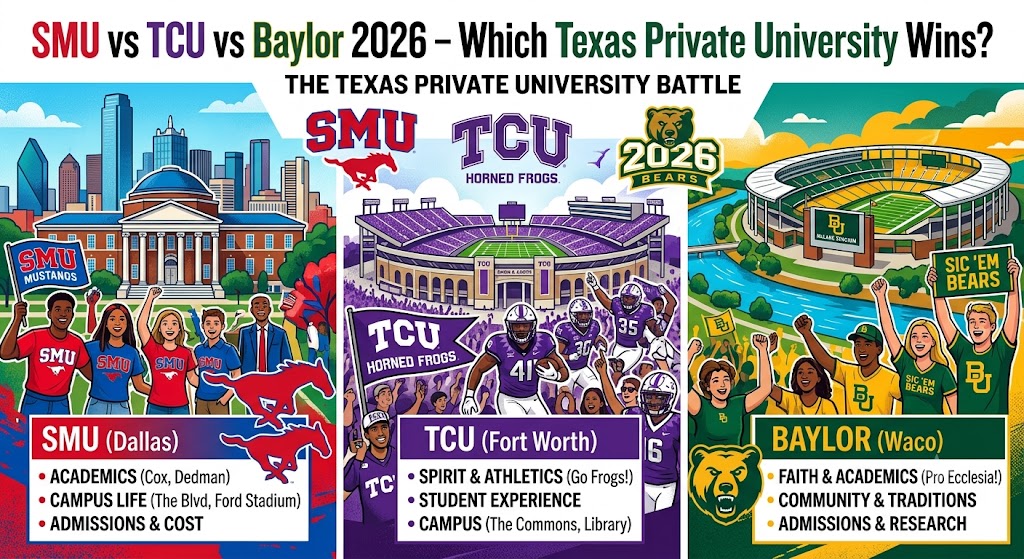
\All three have Division I athletics. And all three will cost you roughly $55,000–$67,000/year in tuition before financial aid. But they are not interchangeable — and choosing the wrong one for your goals, personality, and career direction is a real mistake. This guide gives you the actual data and an honest framework for deciding which one fits you.
Quick Comparison — SMU vs TCU vs Baylor at a Glance
| Category | SMU (Dallas) | TCU (Fort Worth) | Baylor (Waco) |
|---|---|---|---|
| US News Ranking (2026) | #61 National | #72 National | #91 National |
| Location | University Park, Dallas | Southwest Fort Worth | Waco (I-35 corridor) |
| Affiliation | United Methodist | Disciples of Christ | Baptist (BGCT) |
| Total Enrollment | ~11,842 | ~12,785 | ~20,824 |
| Acceptance Rate | ~47–63% | ~44–56% | ~51% |
| Average SAT (Admitted) | 1,420 | 1,250 | 1,250–1,280 |
| Average ACT (Admitted) | 32 | 29 | 27–30 |
| Student-to-Faculty Ratio | 11:1 | 14:1 | 15:1 (avg class 26) |
| Tuition & Fees | ~$67,040 | ~$61,740 | ~$54,844 |
| Average Net Price | ~$45,792 | ~$39,005 | ~$49,727 |
| Avg Aid per Student | $36,850 (69% receive) | $33,813 (81% receive) | $28,342 (97% receive) |
| 6-Year Graduation Rate | 84% | 86% | 72% |
| 1st-Year Retention Rate | 91% | 93% | 87% |
| Median Salary (10 yrs) | $73,000 | $57,600 | $56,200 |
| Median Student Loan Debt | $21,500 | $21,500 | $25,000 |
| Graduate Placement Rate | 93% within 2 yrs | 80% within months | 94.8% within 6 months |
| Business School | Cox (AACSB) — #18 MBA | Neeley (AACSB) — #25 MBA | Hankamer (AACSB) |
| Law School | Dedman (ABA) | TCU Law (ABA) — #22 | Baylor Law (ABA) — #74 |
| Research Status | R1 (Carnegie 2025) | Not R1 | R1 (Carnegie 2023) |
| Athletics | NCAA D1 — AAC | NCAA D1 — Big 12 | NCAA D1 — Big 12 |
| No App Fee (Intl UG) | No ($75) | No ($75) | ✅ Yes — free |
1. Rankings and Prestige — SMU Leads, But Not by as Much as You’d Think
SMU — Highest Nationally, Fastest Rising
SMU ranks #61 nationally — the highest of the three — and earned a significant milestone in 2025: R1 Doctoral University — Highest Research Activity classification from Carnegie. That makes SMU one of only two private universities in Texas with R1 status (alongside Rice). SMU’s new R1 standing reflects a decade of deliberate investment in doctoral programs and research output, and it meaningfully strengthens the university’s academic profile.
SMU also consistently scores well on salary outcomes — a median graduate salary of $73,000 at 10 years, the highest of the three by a significant margin ($15,400 more than TCU, $16,800 more than Baylor). That premium is driven by SMU’s Dallas location, the strongest of the three cities for finance, consulting, and technology careers.
TCU — Most Selective, Best Big 12 Platform
TCU ranks #72 nationally and has one of the most compelling athletic and academic combinations in the group. With a 44–56% acceptance rate — the most selective of the three — and the strongest law school (#22 nationally, #3 in dispute resolution), TCU’s academic profile punches above its overall ranking. The Big 12 Conference membership gives TCU national athletic visibility and alumni engagement depth that SMU’s AAC affiliation currently cannot match.
TCU also has the best net price outcome of the three: the average student pays $39,005/year after aid — $6,787 less than SMU and $10,722 less than Baylor. The 70% debt-free graduation rate at TCU is one of the strongest financial outcomes metrics at any private Texas university.
Baylor — Lowest Tuition, Highest Aid Coverage
Baylor ranks #91 nationally — lowest of the three — but has the lowest listed tuition ($54,844) and the highest percentage of students receiving aid (97%). Baylor is also R1-classified (since 2023), putting it in the same research tier as SMU despite the lower prestige ranking.
Where Baylor genuinely leads: the 94.8% graduate placement rate within 6 months is the best of the three, and the Baylor Law School’s practice court program is nationally recognized for producing practice-ready attorneys. For students who want strong career outcomes at the lowest net cost of the group, Baylor makes a compelling case.
2. Tuition, Net Price and Financial Aid — TCU Is the Best Deal
| Factor | SMU | TCU | Baylor |
|---|---|---|---|
| Listed Tuition | $67,040 | $61,740 | $54,844 |
| Average Net Price | $45,792 | $39,005 | $49,727 |
| Students Receiving Aid | 69% | 81% | 97% |
| Average Aid Per Student | $36,850 | $33,813 | $28,342 |
| % Graduating Debt-Free | Not reported | 70% | Not reported |
| Median Student Loan Debt | $21,500 | $21,500 | $25,000 |
The numbers tell a clear story: TCU has the lowest average net price at $39,005/year — $6,787 less than SMU and $10,722 less than Baylor. That gap over four years translates to approximately $27,000–$43,000 in total savings over a degree. TCU and SMU graduates share the same median student loan debt ($21,500), while Baylor graduates carry $3,500 more.
Baylor’s 97% aid coverage is remarkable — essentially every full-time student gets something. But the average package ($28,342) is the smallest of the three, and the net price ($49,727) is the highest, suggesting Baylor’s aid covers a smaller proportion of a smaller sticker price rather than making it the cheapest option in practice.
SMU’s highest average aid package ($36,850) offsets some of the highest sticker price, but the 69% coverage rate means more than 3 in 10 SMU students receive nothing institutional. SMU is also need-aware for international applicants, requiring demonstrated ability to contribute at least $40,000/year.
For international students: Baylor has a distinct advantage — no application fee for international undergraduates, and holistic merit scholarship consideration through the same admissions process used for domestic students. SMU and TCU both charge $75 for international applications and are need-aware (financial circumstances considered in admissions).
3. Best Programs — Where Each School Leads
| Field | SMU Advantage | TCU Advantage | Baylor Advantage |
|---|---|---|---|
| Business / MBA | ✅ Cox #18 MBA nationally; highest salaries | ✅ Neeley #25 MBA; 94.1% employment | Hankamer AACSB; 80% placement |
| Law | Dedman ABA | ✅ #22 nationally; #3 dispute resolution | Baylor Law #74; best trial advocacy |
| Data Science / CS | ✅ Lyle Engineering; STEM/tech focus | CS program | Growing R1 CS program |
| Nursing | Not a focus | ✅ Harris College of Nursing — ACEN accredited | ✅ Louise Herrington Nursing — ACEN accredited |
| Pre-Health / Pre-Med | Good access | Pre-health advising | ✅ 80–90% professional school acceptance |
| Communication / Media | ✅ Meadows Arts; Dallas media access | Bob Schieffer College — nationally recognized | Baylor Journalism program |
| Music / Fine Arts | Meadows School of the Arts | College of Fine Arts | ✅ NASM-accredited music school |
| Research Opportunities | ✅ R1; $700M+ research | Not R1 | ✅ R1 since 2023; biomedical focus |
| Public Policy / Theology | Not a focus | Religion/Philosophy strong | ✅ Truett Seminary; faith integration |
| Athletics Visibility | AAC — moderate | ✅ Big 12 — elite | ✅ Big 12 — national championships |
4. Location — Dallas vs Fort Worth vs Waco
All three schools are in North/Central Texas, but the campus locations create meaningfully different student experiences.
SMU — University Park, Dallas
SMU’s campus in University Park is embedded in one of Dallas’s most upscale residential neighborhoods — affluent, polished, and immediately adjacent to the city’s corporate and social infrastructure. The George W. Bush Presidential Center is on campus.
The #1 U.S. metro for STEM jobs (DFW) means SMU students have access to the deepest technology, finance, consulting, and defense employer base of the three. Living costs in University Park are the highest of the three locations — off-campus housing often exceeds $1,500/month — and the campus, while beautiful, lacks the traditional feel of Baylor’s Brazos River setting or TCU’s tree-lined campus.
TCU — Southwest Fort Worth
TCU’s 300-acre campus in southwest Fort Worth has distinctive collegiate Gothic architecture and the feel of a traditional residential university campus — complete, self-contained, and genuinely beautiful. Fort Worth is the more livable of the two DFW cities for students: lower cost than Dallas, with a genuine cultural identity including the Kimbell Art Museum, the Fort Worth Stockyards, and Sundance Square.
The #2 U.S. job market for multiple industries means career access is strong without being overwhelming. TCU feels more like a “college” than SMU — less urban, more community.
Baylor — Waco, on the Brazos River
Baylor’s 1,000-acre campus along the Brazos River in Waco is genuinely scenic — and Waco itself has been transformed over the past decade by the Chip and Joanna Gaines effect, with downtown revitalization, new restaurants, and millions of annual visitors drawn to Magnolia Market.
Waco’s cost of living is 10% below the national average — the most affordable of the three locations by a clear margin. The tradeoff: Waco is smaller than Dallas or Fort Worth, and while Austin and Dallas are each about 100 miles away, neither is truly in commuting distance for daily access. Baylor students who want Waco need to be content with Waco — at least during the week.
5. Campus Culture — Three Very Different Feels
SMU — Preppy, Ambitious, City-Connected
SMU’s campus culture has a reputation — sometimes deserved, sometimes caricatured — for affluence and social exclusivity. The university is working deliberately to diversify its student body and campus culture, but the reality is that SMU attracts students who are ambitious, career-focused, and often from upper-income backgrounds.
The campus social scene integrates with Dallas’s restaurant and nightlife infrastructure in a way that students either love (city access is immediate) or find unsatisfying (campus community can feel transient). Greek life is visible and active but not dominant.
TCU — Community, Tradition, Big 12 Energy
TCU’s campus culture has the strongest sense of community of the three — a genuine collegiate atmosphere where students feel like they belong to something. The Big 12 football program — culminating in the College Football Playoff National Championship game — has supercharged TCU’s campus energy and national recognition.
Horned Frog game days in Fort Worth are genuinely special. The student body is diverse enough to feel interesting but small enough (12,785 students) that you encounter the same people repeatedly, building actual community. The Disciples of Christ affiliation is lighter-touch than Baylor’s Baptist identity — faith is present but not pervasive in the social experience.
Baylor — Faith-Forward, Tradition-Rich, Midsize
Baylor’s Baptist affiliation is genuine and active. Chapel programs, campus ministries, and an explicit integration of faith and academics shape the student experience in ways that are real, not just institutional. Students who come to Baylor for the faith community find it — consistently and authentically.
Students who come despite it generally find the campus welcoming but the culture unmistakably Christian. Baylor is larger than SMU or TCU at 20,000+ students, which gives it more program depth and organizational variety but makes the community feel less intimate than TCU or SMU. The NCAA basketball championship and strong recent athletic performance have added energy to campus life.
6. Career Outcomes — The Numbers Don’t Lie
| Outcome | SMU | TCU | Baylor |
|---|---|---|---|
| Median Salary (10 years) | $73,000 | $57,600 | $56,200 |
| Graduate Placement Rate | 93% (within 2 yrs) | 80% (within months) | 94.8% (within 6 months) |
| MBA Starting Salary | Top of market | $109,000+ (Neeley) | Strong regional |
| Neeley BBA Employment | N/A | 94.1% (within 3 months) | N/A |
| Law School Rank | Dedman (ABA) | #22 nationally | #74 nationally |
| Best Career City Access | Dallas — #1 STEM jobs | Fort Worth/DFW — #2 market | Waco (Austin/Dallas access) |
The $73,000 10-year median salary at SMU compared to $57,600 at TCU and $56,200 at Baylor is a significant gap — roughly $15,000–$17,000/year more at the 10-year point. Over a career, that compounds dramatically. SMU’s salary premium reflects both the Dallas location advantage and the Cox School’s finance, consulting, and tech placement network.
However: SMU’s higher salary outcomes come with a higher net price ($45,792/year). Whether the salary premium justifies the additional cost depends on your field. For finance and consulting — SMU’s ROI is clear. For education, healthcare, or ministry — Baylor’s lower cost and strong placement rate may serve you better.
TCU’s 70% debt-free graduation rate is the standout financial outcomes metric of the group — suggesting TCU students are better at managing the cost of private education relative to their income expectations than SMU or Baylor students.
7. For International Students — Key Differences
| Factor | SMU | TCU | Baylor |
|---|---|---|---|
| Application Fee (Intl UG) | $75 | $75 | ✅ Free |
| Need-Aware Admissions | Yes ($40K+ contribution) | Yes | Holistic review |
| International Scholarship | Automatic merit consideration | $25,000/yr avg; max $51,570 | Merit auto-reviewed at admission |
| STEM OPT (36 months) | ✅ Engineering, CS, Sciences | ✅ Engineering, Sciences | ✅ Engineering, CS, Sciences |
| Best City for Intl Career | ✅ Dallas tech/finance | ✅ DFW — balanced | Austin access (100 miles) |
For International Students Specifically: Baylor’s free application and holistic merit scholarship review make it the easiest to apply to and the most accessible of the three. TCU’s $25,000/year average international aid package and lower net price ($39,005) make it the most financially competitive once admitted.
SMU’s Dallas location gives the best career access for international students targeting U.S. tech or finance careers, but requires demonstrated financial ability of $40,000+/year at the admissions stage.
Who Should Choose SMU?
SMU is likely the best fit if you:
- Are targeting a career in finance, consulting, data science, or technology where Dallas’s employer ecosystem and SMU’s Cox/Lyle networks create direct pathways
- Want the highest prestige ranking of the three (#61 nationally) and R1 research access
- Have strong test scores (median SAT 1,420 / ACT 32) and GPA that position you competitively
- Can contribute at least $40,000/year toward educational costs (international students)
- Want a small-class urban university experience — 11:1 ratio, average class size 22, embedded in Dallas
- Value the George W. Bush Presidential Center on campus and connections to Dallas’s political and business elite
Who Should Choose TCU?
TCU is likely the best fit if you:
- Want the best net price of the three ($39,005/year average) and the strongest debt-free graduation rate (70%)
- Are pursuing law — TCU’s Schieffer Law (#22 nationally, #3 dispute resolution) is the best law school of the group
- Want Big 12 athletics with national championship football energy — TCU’s 2022 CFP run changed the school’s national profile permanently.
- Are interested in nursing, business (Neeley BBA 94.1% employment), or communications
- Want a genuine college campus community feel in the more livable of the two DFW cities.s
- Value the most selective admissions profile of the three (44–56%) as a prestige signal.
Who Should Choose Baylor?
Baylor is likely the best fit if you:
- Want a faith-integrated campus environment that is genuinely Baptist and active — not just nominally affiliated
- Are pursuing pre-health professions — Baylor’s 80–90% professional school acceptance rate is the best of the three
- Want the lowest listed tuition ($54,844) and the highest percentage of students receiving aid (97%)
- Are an international student who benefits from no application fee and holistic merit scholarship review
- Are interested in trial law — Baylor Law’s practice court program is nationally recognized for producing practice-ready litigators.s
- Want a scenic riverside campus in a college town that has genuinely improved over the past decade (Chip and Joanna Gaines effect)
- Want the highest graduate placement rate of the three (94.8% within 6 months)
The Bottom Line
There is no universally correct answer here — SMU, TCU, and Baylor are all excellent private universities, and all three will serve students well who understand what they’re choosing and why.
Choose SMU if career-focused, Dallas-anchored, finance or tech career outcomes are your priority — and you can stomach the higher net price in exchange for the highest 10-year salary outcomes.
Choose TCU if you want the best financial value of the three, the strongest law school, Big 12 athletic energy, and a genuine college-community feel in the more livable of the DFW cities.
Choose Baylor if faith integration matters deeply to you, pre-health is your academic goal, you want the highest placement rate of the three, or you’re an international student who wants the easiest and most accessible application process of the group.
Full University Guides
For complete details on each university — including full tuition tables, scholarship breakdowns, and step-by-step application guides — see our individual profiles:
- Southern Methodist University (SMU) — Full Guide
- Texas Christian University (TCU) — Full Guide
- Baylor University — Full Guide
For broader Texas university comparisons, see:
- UT Austin vs Texas A&M — Which Is Right for You?
- Rice University — Full Guide
- Texas Universities with Full Scholarships for International Students
- 10 Cheapest Universities in Texas for International Students
Deciding between SMU, TCU, and Baylor? Tell us your major and career goals in the comments — we’ll give you our honest take on which is the better fit.
Leave a Reply