Texas is home to some of the most respected universities in the United States — from flagship research institutions like UT Austin and Texas A&M to affordable private universities like Texas Lutheran and Wayland Baptist. For international students, Texas offers world-class education, a booming job market, and a welcoming multicultural environment.
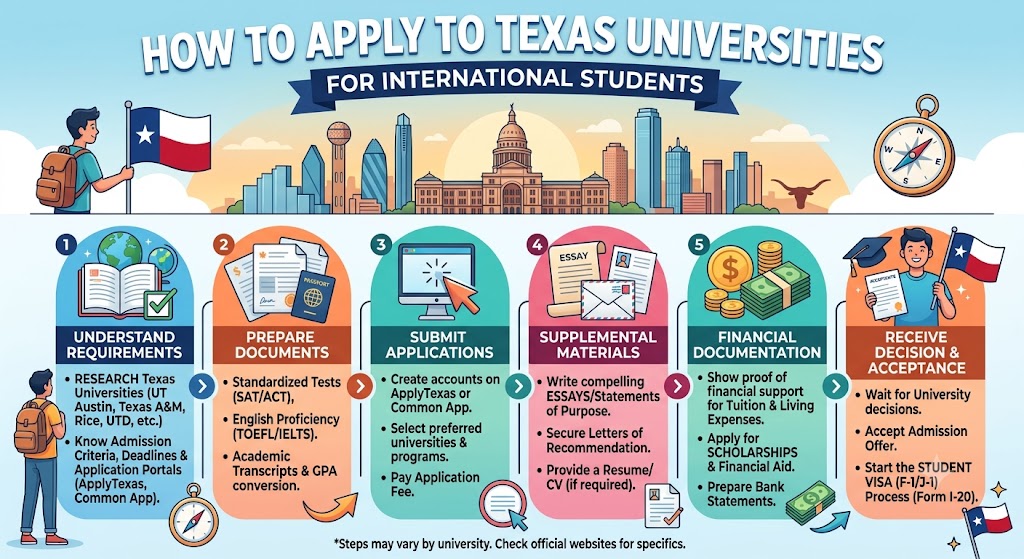
But the application process can feel overwhelming if you are doing it for the first time. This step-by-step guide covers everything you need to know — from choosing a university to arriving on campus with your F-1 visa in hand.
Step 1 — Choose the Right Texas University
Texas has over 150 colleges and universities. Before applying, narrow down your choices based on these factors:
- Your Major or Program — Not every university is strong in every field. UT Austin is known for Engineering and Business. Texas A&M is excellent for Agriculture, Engineering, and Veterinary Science. Texas Lutheran is strong in Biology and Pre-Med.
- Tuition Budget — Public universities charge more for international students (typically $20,000–$35,000/year). Private universities can be cheaper after scholarships.
- Location — Do you prefer a big city (Houston, Dallas, Austin, San Antonio) or a smaller college town? The cost of living varies significantly.
- Acceptance Rate — UT Austin has an acceptance rate of around 31%. Most other Texas universities are above 60%, making them more accessible.
- STEM Designation — If you plan to work in the USA after graduation, check if your program is STEM-designated for extended OPT eligibility.
Tip: Apply to at least 3–5 universities — one reach school, two target schools, and one safety school.
Step 2 — Check Admission Requirements
Every Texas university has slightly different requirements, but here is what almost all of them ask for:
Academic Requirements
- High School Transcript (for undergraduate applicants) — must show all courses and grades. Non-English documents need a certified English translation.
- University Transcript (for graduate or transfer applicants) — official transcripts from all previously attended institutions
- Minimum GPA — most Texas universities require a 2.5–3.0 GPA equivalent. Competitive programs may require 3.5+
- SAT/ACT — most Texas universities are now test-optional for 2026. Check each university’s specific policy.
English Proficiency Requirements
| University | TOEFL iBT Minimum | IELTS Minimum | Duolingo |
|---|---|---|---|
| UT Austin | 79 | 6.5 | Not accepted |
| Texas A&M | 80 | 6.0 | Not listed |
| Texas State University | 78 | 6.0 | Accepted |
| Texas Lutheran University | 79 | 6.0 | Check with the university |
| Wayland Baptist University | 61 | 5.5 | Accepted |
| UT El Paso (UTEP) | 79 | 6.0 | Accepted |
| Texas A&M International (TAMIU) | 79 | 6.0 | Check with the university |
Note: Some universities offer conditional admission with lower English scores if you enroll in their English language program first.
Step 3 — Prepare Your Application Documents
Most Texas universities accept applications through ApplyTexas (applytexas.org) or the Common App (commonapp.org). Here is the standard checklist of documents you will need:
For Undergraduate (Bachelor’s) Applicants:
- ✅ Completed online application (ApplyTexas or Common App).
- ✅ Official high school transcripts (with English translation if needed).
- ✅ TOEFL / IELTS / Duolingo score reports.
- ✅ Copy of a valid passport.
- ✅ Personal statement/essay (required by most universities).
- ✅ Letters of recommendation (1–3, depending on the university).
- ✅ Financial support documents (bank statement showing funds for 1 year).
- ✅ Application fee ($25–$90 depending on the university).
For Graduate (Master’s / PhD) Applicants:
- ✅ All of the above, plus:
- ✅ Official university transcripts (bachelor’s degree)
- ✅ Statement of Purpose (SOP)
- ✅ GRE / GMAT scores (check if required — many programs are now test-optional)
- ✅ Resume / CV
- ✅ 2–3 Letters of Recommendation from professors or employers
Important: Applicants needing a visa to enter the U.S. should complete all application requirements at least one month before the posted deadline to ensure enough time to complete the visa process.
Step 4 — Application Deadlines
Texas universities typically have two main intakes:
| Intake | Semester Starts | Typical Application Deadline | Recommended Apply By |
|---|---|---|---|
| Fall 2026 | August / September 2026 | December 2025 – March 2026 | October – November 2025 |
| Spring 2027 | January 2027 | September – October 2026 | July – August 2026 |
| Summer 2026 | June 2026 | March – April 2026 | February 2026 |
The fall semester is the most popular intake — more programs, more scholarships, and more international student orientation support.
Step 5 — Apply For Scholarships
Never apply without checking for scholarships. Most Texas universities offer merit-based scholarships to international students at the time of admission — you do not need a separate application in most cases.
- Texas Lutheran University — Presidential Scholarship up to $18,000/year. Apply early for the best consideration.
- Wayland Baptist University — Pioneer Scholarship based on GPA and test scores. Terra Scholarship for international business students.
- Texas A&M International (TAMIU) — International Excellence Scholarship up to $4,000/year.
- UT El Paso — International Student Excellence Scholarship and departmental awards.
- Texas State University — Bobcat Scholarship and International Student Merit Award.
Tip: Email the international student office of each university and directly ask: “What scholarships are available for international students, and what is the deadline?” This one email can save you thousands of dollars.
Step 6 — Receive Your Acceptance & Request Your I-20
Once you are accepted, the university will ask you to confirm your enrollment and submit financial documents. After verifying your finances, they will issue your Form I-20 — the most important document in your international student journey.
The I-20 is your Certificate of Eligibility for the F-1 Student Visa. Without it, you cannot apply for your student visa.
To receive your I-20, you will typically need to provide:
- Bank statement showing sufficient funds (usually 1 full year of tuition + living costs)
- Sponsor letter (if someone else is funding your education)
- Copy of your passport
Step 7 — Apply For Your F-1 Student Visa
Once you have your I-20, you can start the F-1 visa application process. Here is the complete sequence:
Step 7a — Pay the SEVIS Fee
After obtaining the I-20 form, you must pay the SEVIS I-901 fee to register your information in the Student and Exchange Visitor Information System (SEVIS). F-1 students pay $350 for the SEVIS fee. The fee is non-refundable, even if the visa application is denied. Pay at fmjfee.com and save your receipt.
Step 7b — Complete DS-160 Form
The DS-160 is the online US visa application form. Fill it carefully at ceac.state.gov. You will need your passport, I-20, and a digital photo. The DS-160 application fee is $185.
Step 7c — Schedule Visa Interview
Book your F-1 visa interview at the nearest US Embassy or Consulate. Wait times vary by country and season — book as early as possible, ideally 3–4 months before your program start date.
Step 7d — Attend Visa Interview
Bring these documents to your interview:
- Valid passport (with at least 6 months’ validity beyond your program end date).
- DS-160 confirmation page.
- SEVIS fee receipt (I-901).
- Form I-20 (signed by you and your DSO).
- University acceptance letter.
- Financial documents (bank statements, scholarship letters).
- Passport-sized photos.
- Academic documents (transcripts, TOEFL/IELTS scores).
At the interview, the consular officer will ask why you want to study in the USA, which university you are attending, how you will fund your education, and your plans after graduation. Be honest, confident, and prepared.
Step 7e — Enter the USA
You may enter the U.S. no earlier than 30 days before the start date indicated on your Form I-20. When you arrive at a U.S. port of entry, a CBP officer will review your documents, including your passport, F-1 visa, and Form I-20.
Step 8 — Arrive on Campus & Complete Check-In
After arriving in the USA, you must report to your university’s International Student Office (also called DSO — Designated School Official) within 30 days of your program start date. They will confirm your arrival in the SEVIS system and help you get settled.
On arrival, you will typically need to:
- Attend international student orientation
- Register for full-time classes (F-1 students must maintain full-time enrollment)
- Get your student ID and activate your university email
- Set up a US bank account (bring your passport, I-20, and university acceptance letter)
- Get your Social Security Number (SSN) if working on campus
Common Mistakes International Students Make
- Applying too late — International applications need extra time for document verification and visa processing. Apply 6–8 months before your intended start date.
- Not applying for scholarships — Many students miss scholarship deadlines because they did not ask about them early enough.
- Submitting untranslated documents — All documents not in English must have a certified English translation attached.
- Choosing the wrong TOEFL/IELTS test type — Some universities require IELTS Academic, not IELTS General. Always confirm which test is accepted.
- Not having enough funds in the bank statement — Your bank statement should show enough funds for at least one full academic year before the I-20 is issued.
- Entering on a tourist visa — If you do not receive the Form I-20, do not enter the U.S. on a B-1/B-2 tourist visa. Doing so may prevent you from beginning your academic program on time or make it necessary for you to leave the U.S. to change your status.
Frequently Asked Questions
Can I apply to multiple Texas universities at the same time?
Yes, absolutely. You can apply to as many Texas universities as you want simultaneously. Most use the ApplyTexas or Common App platform. Apply to at least 3–5 universities to maximize your chances of getting accepted with a scholarship.
How much money do I need to show for a Texas university F-1 visa?
You need to show bank statements covering at least one full year of tuition plus living costs. For most Texas universities, this means demonstrating funds of $35,000–$55,000 (approximately ₹29–46 lakh). The exact amount depends on your specific university’s Cost of Attendance.
How long does the F-1 visa process take?
The full F-1 visa process — from receiving your I-20 to attending your visa interview — typically takes 2–4 months. This includes time to pay the SEVIS fee, complete DS-160, and wait for an interview appointment at the US Embassy. Start early.
Can I work while studying in Texas on an F-1 visa?
Yes, F-1 students can work on-campus up to 20 hours per week during the semester and full-time during official university breaks. Off-campus work requires special authorization (CPT or OPT) from your university’s international office.
What is the difference between ApplyTexas and the Common App?
ApplyTexas is a Texas-specific application platform used by most public Texas universities. Common App is a national platform accepted by many private universities, including Texas Lutheran University. Some universities accept both — always check which platform your target university prefers.
Final Checklist — Application Timeline
| Timeframe | What to Do |
|---|---|
| 12 months before | Research universities, take the TOEFL/IELTS, and shortlist programs. |
| 8–10 months before | Request transcripts, write SOP/essays, and ask for recommendation letters. |
| 6–8 months before | Submit applications and email universities about scholarships. |
| 4–6 months before | Receive acceptance letters, confirm enrollment, and request an I-20. |
| 3–4 months before | Pay SEVIS fee, complete DS-160, schedule a visa interview. |
| 1–2 months before | Attend visa interview, book flights, arrange housing. |
| 30 days before start | Arrive in the USA, check in with the international office. |
Looking for affordable Texas universities? Read our guide on the 7 Cheapest Universities in Texas for International Students 2026. Questions about specific universities? Leave a comment below!
Leave a Reply